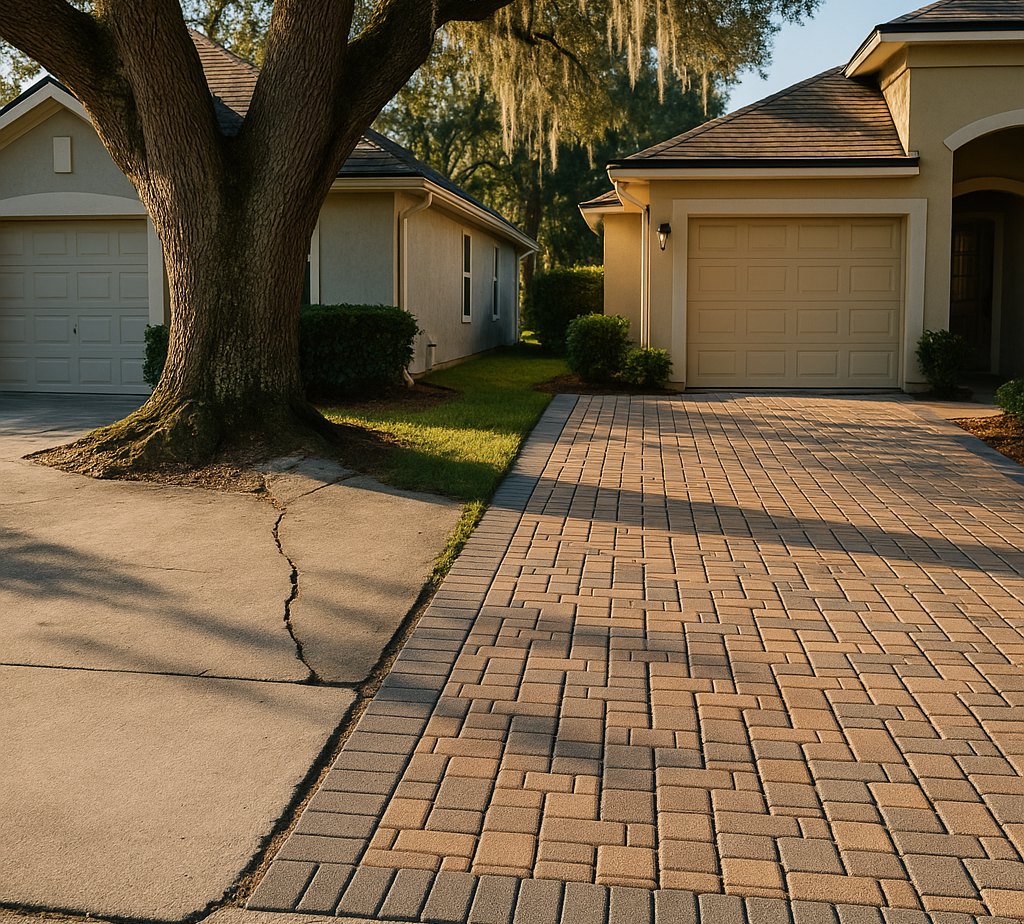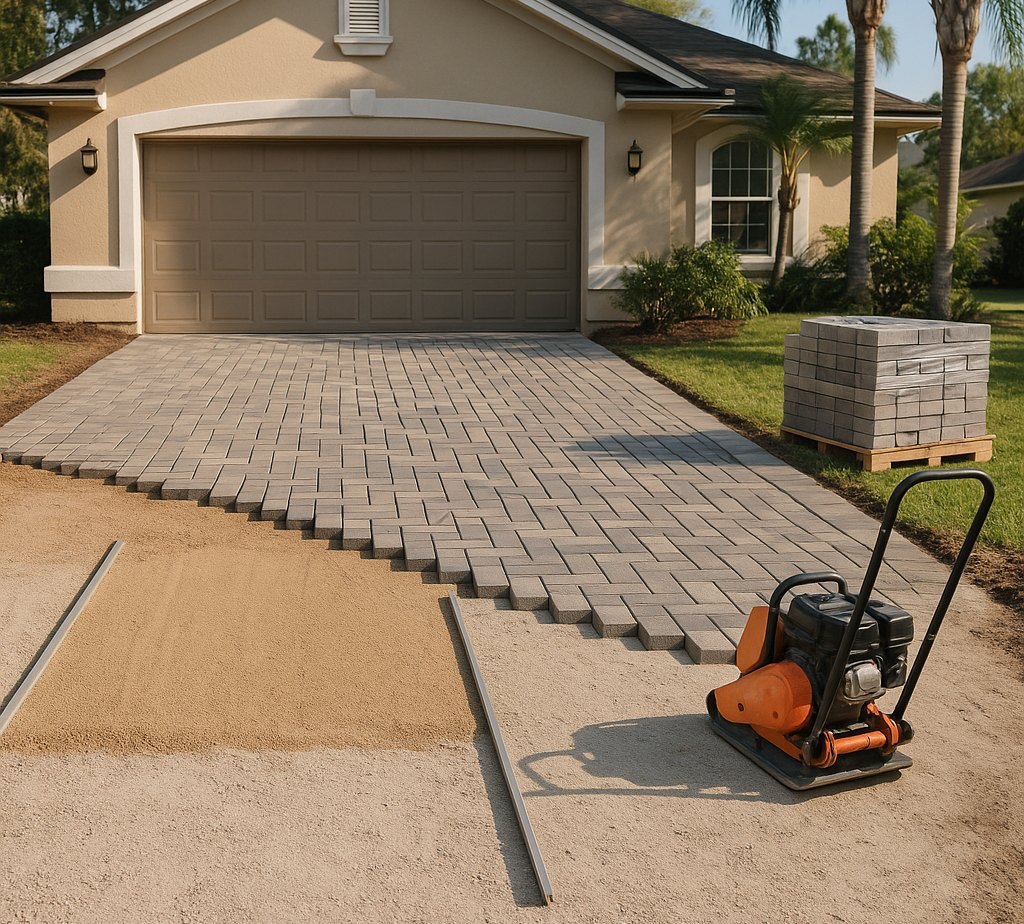
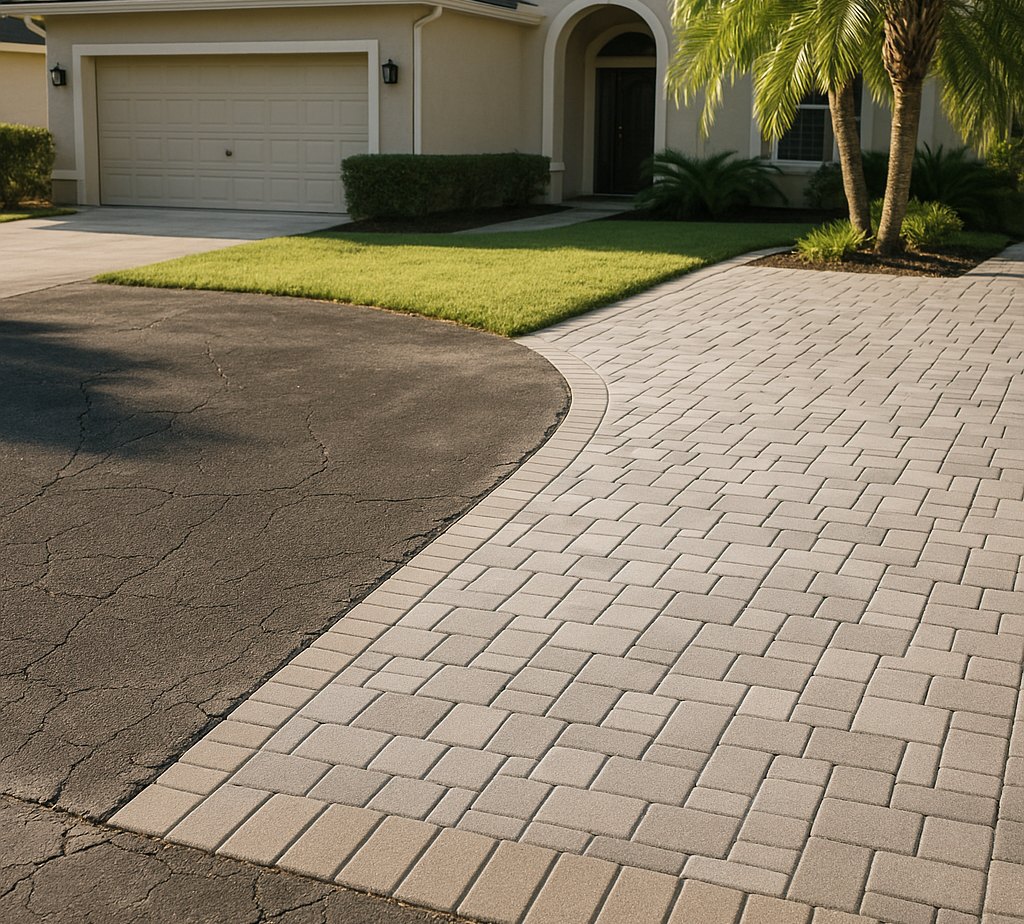
Every week a Jacksonville homeowner asks me the same question: “Is it really worth paying triple for pavers when asphalt looks fine?” It is a fair question, and the honest answer surprises people. On day one, asphalt wins on price by a wide margin. But the pavers vs asphalt driveway debate is not decided in year one — it is decided around year seven, when the first asphalt resurface bid lands in your inbox. By year twenty, the math in Florida looks completely different than it does in Ohio or Pennsylvania, and that is what most online comparison articles miss. This post walks through the real numbers for an 800 square foot Jacksonville driveway, year by year, with the Florida-specific factors that crater asphalt lifespan along the First Coast.
Upfront Cost: Why Asphalt Wins on Day One
Let me get this out of the way first because I am not going to pretend otherwise: asphalt is genuinely cheaper to install. In the Jacksonville, St. Augustine, and Ponte Vedra market right now, here is what real driveway pricing looks like for an 800 square foot driveway, which is roughly a two-car standard layout.
Asphalt installed: $4 to $7 per square foot, depending on base prep, edge restraint, and the contractor. That works out to $3,200 to $5,600 for an 800 square foot driveway. If you are doing a tear-out and replace on an existing driveway, you can sometimes shave a little off because the base is already compacted.
Concrete pavers installed: $14 to $22 per square foot, depending on the paver style (basic Holland stone vs. tumbled cobble vs. large-format slab), pattern complexity, and whether you need a structural base for vehicle traffic. That works out to $11,200 to $17,600 for the same 800 square foot driveway.
So you are looking at a price gap of roughly $8,000 to $12,000 on day one. That is not nothing, and any contractor who tries to wave it away is not being straight with you. The question is not whether asphalt is cheaper upfront — it is. The question is what happens between year one and year twenty.
What That Asphalt Price Actually Includes
A real $5,600 asphalt driveway in Jacksonville should include a 4-inch base of crushed limerock or concrete millings, a 2-inch compacted asphalt surface course, edge cleanup, and a 30-day cure period before you drive on it. If you are getting bids under $4 per square foot, ask hard questions about base depth and asphalt mix. Florida has a habit of producing thin, under-compacted asphalt jobs that fail in three to five years.
Why Florida Heat Destroys Asphalt Faster Than the Brochure Says
Asphalt is petroleum. Specifically, it is aggregate held together by a binder made from the heaviest fractions of crude oil. That binder has a softening point — the temperature where it starts losing structural integrity — that typically sits between 115 and 130 degrees Fahrenheit for residential driveway mixes. Now, look at the surface temperature of a black driveway in Jacksonville in July when the air temperature hits 95 and the sun is direct. Asphalt surface temperatures routinely hit 140 to 160 degrees. The binder softens. Cars sitting in the same spot leave depressions. Trailer jacks punch holes. Power steering scrubs leave permanent gouges.
Then UV oxidation kicks in. Sunlight breaks down the asphalt binder over time, which is why every black asphalt driveway turns gray and chalky after a few years. That oxidized layer is brittle and starts hairline cracking, and once water gets into a hairline crack in Florida, you are on a fast track to alligator cracking and edge failure. Northern asphalt lasts 20 to 25 years partly because the sun is weaker and the temperature swings, while harsh in winter, do not bake the binder six months a year. Florida asphalt does not get that grace.
Sandy Soil, Stormwater, and Edge Failure
Most of Northeast Florida sits on sandy, fast-draining soil. That is great for not flooding your yard, but it is a problem for asphalt edges. When you get a typical August thunderstorm dropping two inches in forty minutes, the runoff hits the edge of an asphalt driveway and starts undercutting it. The sandy base shifts, the asphalt edge no longer has support, and within a year or two you have a crumbling lip along your driveway. I see this on three-year-old asphalt driveways constantly. The fix involves cutting back the failed edge and patching, which is visible and ugly.
Hurricane season makes it worse. Standing water under loose or cracked asphalt is the main ingredient in pothole formation. Water gets in, the base saturates and weakens, traffic flexes the asphalt, and the surface fails from underneath. After a wet hurricane season I get pothole repair calls every September.
Salt Air on the Coast
If you live in Ponte Vedra, Atlantic Beach, Vilano, or anywhere within a couple miles of the ocean, salt air accelerates asphalt oxidation noticeably. The salt does not eat asphalt the way it eats steel, but it does speed the breakdown of the binder and shortens the interval between sealcoats. Coastal driveways usually need sealcoat every 24 months instead of every 30 to 36.
Maintenance Costs Over 20 Years: Where the Math Flips
This is the section that changes minds. Most homeowners price out the install and stop there. They do not factor in the recurring cost of keeping asphalt functional in Florida. Let me lay it out.
Asphalt Maintenance Schedule for Jacksonville
Sealcoating: Asphalt needs to be sealcoated every 2 to 3 years in Florida (vs. 4 to 5 years in northern climates) because of UV exposure and heat. At $0.20 to $0.40 per square foot, that is $160 to $320 per sealcoat for an 800 square foot driveway. Over 20 years you will sealcoat 7 to 10 times, totaling $1,200 to $3,200.
Crack filling: Hairline cracks start showing up around year 3 and need to be sealed before they widen. Budget $150 to $300 every couple of years, so figure $750 to $1,500 across 20 years.
Pothole patching: Once you hit year 8 to 10, expect at least one or two pothole repairs. Cold patch is a temporary band-aid; a proper hot patch from a contractor runs $200 to $500 per spot. Budget $400 to $1,000.
Full resurface (overlay) at year 12 to 15: This is the big one. A 2-inch asphalt overlay over your existing driveway in Jacksonville runs $3 to $5 per square foot, so $2,400 to $4,000 for the 800 square foot driveway. Some contractors will tell you that overlays last another 10 to 15 years. In Florida, expect 8 to 12 if the underlying base is still good.
Total asphalt maintenance over 20 years: roughly $4,750 to $9,700. That is on top of the $3,200 to $5,600 you spent to install it.
Paver Maintenance Schedule
Polymeric sand replenishment: The joints between pavers hold polymeric sand that locks them together and prevents weed growth. In Florida, that sand needs a top-up every 5 to 7 years. A pro service for an 800 square foot driveway runs $300 to $600. Over 20 years, figure 3 sand replenishments at $300 to $600 each, or $900 to $1,800 total. If you are handy, the materials cost is closer to $80 a round.
Sealing (optional): Some homeowners seal pavers to enhance color and resist staining. This is purely optional — it is not structural. If you choose to seal, budget $1.00 to $1.50 per square foot every 4 to 6 years, so $800 to $1,200 per round, 3 to 4 rounds over 20 years. Most of my clients skip this.
Individual paver replacement: The beauty of pavers is that if one cracks or stains badly, you pull it out and drop a new one in. Maybe one or two pavers need replacing over 20 years from a dropped tool, oil leak, or impact. Call it $50 to $200 in materials and labor.
Total paver maintenance over 20 years: $1,000 to $1,500 if you skip optional sealing. Even if you choose to seal, you are still well under what asphalt costs to maintain.
Lifespan Reality Check in Jacksonville
Marketing claims for asphalt say “20 to 30 years.” Marketing claims for pavers say “lifetime.” Neither is honest. Here is what I actually see on Jacksonville driveways after thirty years of installing and repairing both materials.
Asphalt: Functional for 12 to 18 years before a major resurfacing decision is forced. After resurfacing once (year 12 to 15), expect another 8 to 12 years before you are back at the same decision point. By year 25 to 30, the base itself has usually failed and you are looking at a full tear-out.
Pavers: 30 to 50 years for the pavers themselves, assuming proper installation with a 6 to 8 inch compacted base, geotextile fabric, 1-inch bedding sand, and proper edge restraints. The pavers do not break down — concrete keeps getting harder for decades. What can fail is the base if a tree root pushes through, which is fixable by lifting the affected section, repairing the base, and resetting the same pavers. The original Roman roads were paved in stone for a reason.
This is where Coastal Driveway Pavers spends most of our time educating homeowners — the lifespan difference is not 20% or 30%, it is roughly 2 to 3x. A driveway you put in at age 35 with pavers might be the last driveway you ever buy for that house. An asphalt driveway at age 35 will be replaced or resurfaced two to three times before you sell or downsize.
20-Year Total Cost of Ownership: The Year-by-Year Table
Let me show you the running total side-by-side. I am using mid-range pricing for both: $5/sq ft for asphalt installed and $17/sq ft for pavers installed on an 800 square foot driveway.
| Year | Asphalt running total | Pavers running total | Notes |
|---|---|---|---|
| 1 (install) | $4,000 | $13,600 | Pavers $9,600 more upfront |
| 3 (first sealcoat) | $4,240 | $13,600 | Asphalt sealcoat $240 |
| 5 (sand top-up) | $4,440 | $14,000 | Asphalt + crack fill $200; pavers polymeric sand $400 |
| 6 (sealcoat) | $4,680 | $14,000 | |
| 9 (sealcoat + crack) | $5,120 | $14,000 | |
| 11 (sand top-up) | $5,120 | $14,400 | |
| 12 (sealcoat + first pothole) | $5,660 | $14,400 | |
| 14 (full asphalt resurface) | $8,860 | $14,400 | $3,200 overlay |
| 17 (sealcoat on new overlay) | $9,100 | $14,800 | Pavers sand top-up $400 |
| 20 (sealcoat + paver swap) | $9,440 | $14,900 | One paver replaced $100 |
Total over 20 years on the mid-range numbers: asphalt $9,440, pavers $14,900. The pavers are still about $5,400 more expensive — but here is what that table does not show. At year 20, the asphalt driveway is six years into its overlay and probably 4 to 7 years away from another major decision. The paver driveway is about 35% through its useful life. If you extend the chart to year 30, the pavers cross under asphalt for total cost. By year 35 or 40, asphalt has been re-overlayed or fully torn out and replaced, and pavers are still going.
Bottom line: pavers stop being more expensive somewhere between year 22 and year 28 in Florida, depending on your maintenance discipline and how aggressive your overlay schedule is.
Resale Value and Curb Appeal
I am not a real estate agent and I will not pretend to know exactly what your house will sell for. But I have talked to enough Jacksonville and St. Augustine realtors over the years to know how they describe driveways in listings. Asphalt is described as “blacktop driveway” and is treated as standard. Pavers are described as “paver driveway” or “decorative paver driveway” and listed as an upgrade in the same paragraph as a screened lanai or upgraded landscaping.
Industry data on this varies, but the consistent finding from multiple home value studies is that paver driveways add roughly 3 to 5 percent to perceived home value in Florida coastal markets. On a $500,000 Ponte Vedra or Nocatee home, that is $15,000 to $25,000 of perceived value. On a $300,000 Westside Jacksonville home, it is $9,000 to $15,000. That perception bump alone can close the gap with asphalt before the maintenance math even kicks in.
Appraisers, on the other hand, are more conservative. An appraiser will list pavers as a “superior” driveway condition compared to asphalt’s “average,” but the comparable sales method does not always translate that into dollar-for-dollar valuation. The realtor effect — meaning what buyers will pay — tends to outweigh the appraiser effect.
Drainage, Stormwater, and Florida Impervious Surface Code
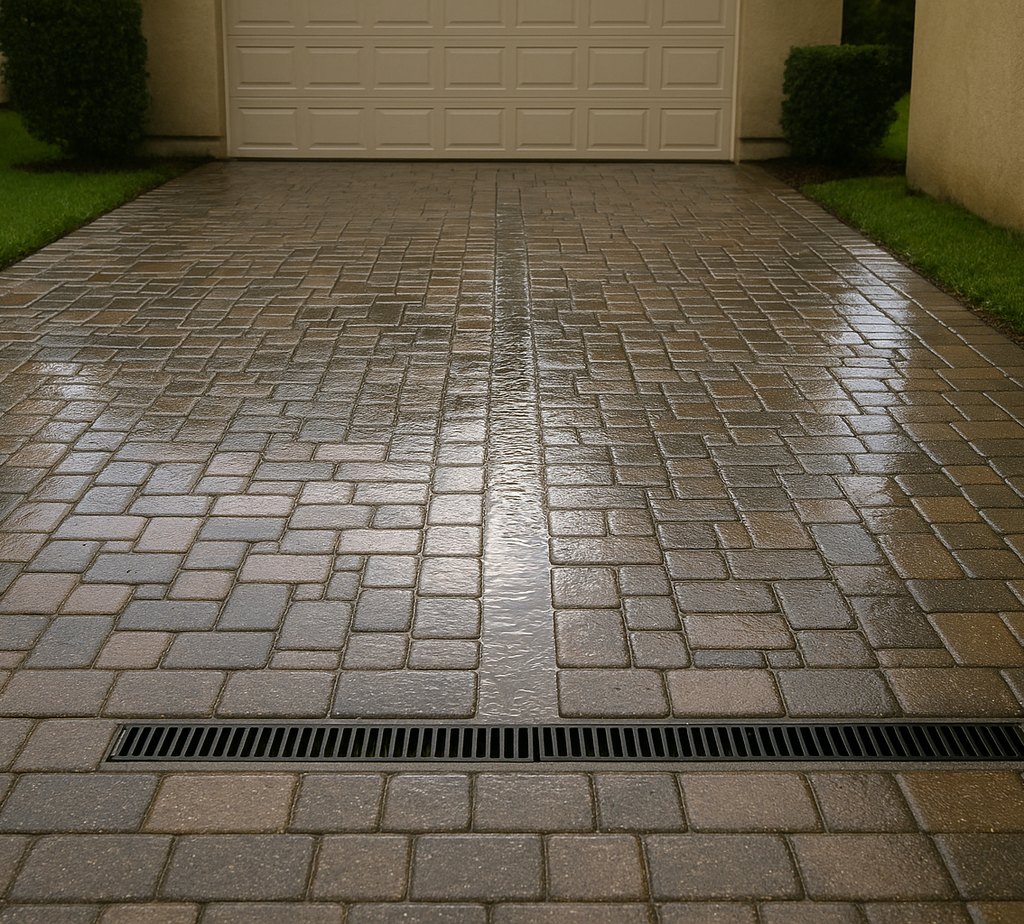
This is a section most contractors will not bring up but it matters in Florida. Asphalt is 100% impervious — every drop of rain that lands on it runs off into your yard, the street, or your neighbor’s property. Standard concrete pavers are about 95 to 98% impervious depending on joint width, which is similar but slightly better. Permeable pavers, which are designed with wider joints filled with crushed stone, can be 80% or more permeable, meaning rain infiltrates straight through into a designed gravel base underneath.
Why does this matter? Several Northeast Florida municipalities, including parts of St. Johns County and the City of Jacksonville, have impervious surface coverage limits in their zoning code. If you are adding to your home — building an addition, putting in a pool, or expanding your driveway — and you are bumping up against your impervious surface cap, choosing permeable pavers can be the difference between getting your permit approved and not. Asphalt offers no such option.
For shoreline and waterfront properties, especially around the Intracoastal in Ponte Vedra and Palm Valley, stormwater runoff regulations are getting tighter every year. Permeable pavers are increasingly the favored choice for new construction near sensitive water bodies because they reduce runoff into stormwater systems and limit nutrient and pollutant transport.
Repair Flexibility: The Hidden Advantage
This is where pavers genuinely shine and asphalt has no answer. If a tree root lifts a section of paver driveway, or if a contractor’s truck cracks one paver during a roof job, the repair is straightforward: lift the affected pavers, fix the base, drop the same pavers back in. The driveway looks identical to the day it was installed because the same materials in the same colors are reset. Most of my repair jobs on paver driveways take half a day and cost a few hundred dollars.
Asphalt repairs are visible. A patch on asphalt is always darker (when fresh) and then lighter (after weathering) than the surrounding surface. A skim-coat patch is even more visible. If you are repairing a 6-foot section of cracked asphalt, you can either patch it (and live with the visible repair until the next sealcoat or resurface evens it out) or you can mill and resurface the entire driveway to keep it uniform. There is no “lift and reset” option.
What This Means When Utilities Need Access
If JEA or a plumber needs to dig up part of your driveway to access a water line, sewer connection, or buried utility, an asphalt driveway requires a saw cut and patch — and that patch will look different forever. A paver driveway gets disassembled in the affected area, the work happens, and the pavers go back in their original positions. This single advantage has saved my Coastal Driveway Pavers clients hundreds of dollars and a lot of aesthetic frustration over the years when they have had to deal with utility work after the fact.
So Which One Is Right for Your Situation?
Here is the honest framework I give homeowners.
Asphalt makes sense if: you are planning to sell within 5 to 8 years, you have a tight upfront budget, you are okay with a utilitarian look, your driveway sees minimal heavy traffic, and you do not mind the every-2-to-3-year sealcoat routine.
Pavers make sense if: you are planning to stay in the home for 10+ years, you can absorb the higher upfront cost, you care about curb appeal and resale value, you live in a coastal area with stricter stormwater rules, you want a driveway that can be repaired without looking patched, or you simply want to stop replacing your driveway every 12 to 15 years.
For most Jacksonville-area homeowners who plan to stay put, the math eventually favors pavers — but you do have to be in the house long enough to get there. If you are going to sell in three years, asphalt is genuinely the financially smarter call.
Considering concrete as well as asphalt? Our pavers vs concrete driveway comparison covers how each one handles sandy soil, live oak roots and heavy vehicles.
Frequently Asked Questions
Are pavers cheaper than asphalt long-term?
In Florida, yes — but only if you stay in the home long enough for the math to flip. On an 800 square foot driveway in Jacksonville, the running total of pavers crosses under the running total of asphalt somewhere between year 22 and year 28 of ownership, factoring in install plus maintenance plus resurfacing. If you sell before then, asphalt was cheaper. If you stay 25+ years, pavers are cheaper and you also avoid two or three messy resurface jobs.
How often does asphalt need to be resealed in Florida?
Every 2 to 3 years is standard for inland Jacksonville and St. Augustine. Coastal properties in Ponte Vedra, Atlantic Beach, and Vilano typically need sealcoat every 24 months because of salt air accelerating UV oxidation. Skipping sealcoats does not save money — it shortens the asphalt’s life dramatically and leads to earlier resurfacing.
How long does asphalt last in Jacksonville?
Realistically, 12 to 18 years before a major resurface decision becomes necessary. After resurfacing, expect another 8 to 12 years. By year 25 to 30, most asphalt driveways in Northeast Florida need a full tear-out because the base has failed. The “20 to 30 year” lifespan claim you see in marketing assumes northern climates with weaker UV and lower temperatures.
Will pavers crack like asphalt?
Concrete pavers can crack from severe impact (think a dropped engine block or a heavy ladder fall) but they do not crack from normal use, heat, or weight. Even when one paver does crack, you replace just that one paver — the rest of the driveway is unaffected. Asphalt cracks are different: a hairline crack spreads, water gets in, the base destabilizes, and what started as a 6-inch crack becomes a 4-foot alligator pattern within a year or two if not addressed.
Can I replace my asphalt driveway with pavers without removing the base?
Almost never, and any contractor who tells you otherwise is cutting a corner that will cost you. Asphalt sits on a base designed for asphalt — typically thinner and less compacted than what pavers need. Pavers require a 6 to 8 inch compacted base with proper geotextile underlayment for vehicle loads. Trying to lay pavers over an asphalt base, or directly over asphalt itself, will result in settling, joint failure, and unevenness within 2 to 3 years. The right way is full asphalt removal, base inspection and rebuild as needed, then proper paver installation. It costs more upfront but it is the only way to get the 30+ year lifespan that makes pavers worth it.