You are not choosing a picture. You are choosing how a few thousand pounds of vehicle gets carried by a few thousand loose units of clay or concrete, every day, for thirty years. Two drives can use the same paver, the same base and the same colour, and one will still be wavy at the garage door in five years because of the layout the crew ran. Pattern is a structural decision that happens to be visible.
So this is not a gallery. Below is what each common pattern does under a car, what it demands from the border, how much cutting it adds at the edges, and where it creates a weak spot. If you want finished layouts first, that is what our driveway paver gallery is for.
The short version. Herringbone, at 45 or 90 degrees, is the only common layout that genuinely interlocks under vehicle loads, which is why it is the driveway default and not the patio default. Running bond, basketweave, circle kits and the French pattern all leave continuous joint lines, so they lean far harder on the base, the edge restraint and the soldier course. Your paver size and shape also decide which patterns are available at all.
What a driveway pattern has to survive
A patio takes people, furniture and a grill: small, vertical loads. A driveway takes a vehicle that brakes, accelerates and, worst of all, turns. Base depth, compaction and paver thickness carry the downward load. The pattern deals with the other two: the horizontal thrust that shoves the surface forward and back every time you brake, and the torsion that twists it when you turn the wheel at low speed.
An interlocked surface behaves like one flexible slab, spreading a wheel load across the units around it. That only happens when no joint line runs continuously in the direction the force is travelling. Think of a long unbroken joint as a rail: give a vehicle a rail to push along and the pavers will slowly walk down it. That one idea explains nearly every rule below.
Herringbone at 45 and 90 degrees, and why it is the driveway default
Herringbone lays rectangular units in interlocking Ls, so no joint runs more than one unit length before another paver blocks it. Push in any direction and the load gets handed sideways instead of sliding.
That is why industry bodies such as the Interlocking Concrete Pavement Institute point to herringbone for vehicular surfaces, and why it is far less common on patios.
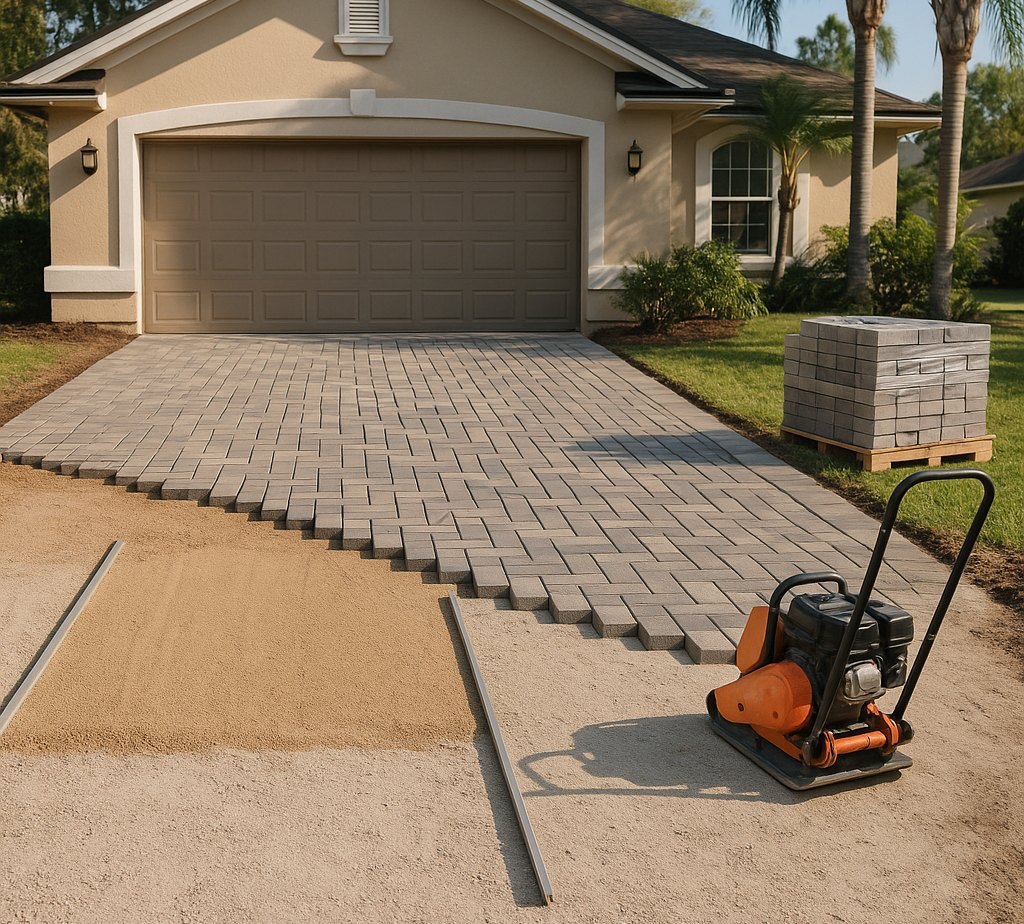
90 degree herringbone runs the Ls square to the drive. The field meets a straight border in a simple sawtooth, so edge cuts are half units: straight, fast, and reusable on the opposite side.
45 degree herringbone rotates the field diagonally, so no joint lines up with the direction you drive or the direction you steer. On a drive that sees a lot of turning it is the stronger of the two. The trade is cutting: the field meets the border in triangles, and a triangle cut off one side will not fit the other without a second cut.
We set this per property, which is what our homepage means by “herringbone, running bond, or a custom layout that reflects your style”.
Running bond and basketweave: the honest limits
Running bond is the staggered brick layout, each course offset by half a unit. It blocks joints in one direction and leaves them continuous in the other, so orientation is critical. Run the long joints across the drive and braking thrust pushes against paver ends rather than down an open channel. Run them with the drive and you have handed traffic a set of rails. Running it across is the version that holds up, and it also makes a narrow drive read wider.
Basketweave alternates pairs of pavers at right angles. The pairs block some movement, but the layout repeats on a square module, so continuous joints reappear every two units in both directions. As a border, an inset panel or an entry feature it works. As the whole field of a drive that turns daily, it is not what we would lay.
Circle kits, fans and the French pattern
Circle kits build concentric rings from tapered units, and they are the most requested feature on a design. Be clear about what one is structurally. Every joint in a circle is radial or circumferential, and both run continuously, so there is no interlock in it anywhere. It also has to be married into the surrounding field, which means a ring of custom cuts all the way round, and those are the smallest, least stable pieces on the drive.
So circles earn their place where wheels do not turn: a courtyard, a widened parking pad, a motor court. Put one in the arc where every car swings in and those cuts are the first thing to work loose.
The French or Versailles pattern is the four size modular layout travertine is usually sold in, and it suits Mediterranean and coastal homes, which is why we offer it in our travertine driveway work. Just understand it is a repeating module with continuous joints at the module boundaries, so it contributes less interlock than herringbone. A thin base under a low interlock pattern is how you end up with a sinking paver driveway.
Paver size and shape decide which patterns are possible
This is where design conversations quietly hit a wall: you cannot lay every pattern in every paver.
Herringbone and basketweave both need a true 2:1 rectangle, twice as long as it is wide, such as a 4 by 8. If the unit is 6 by 9, the halves never land on the joint lines and the pattern will not close. Square units cannot produce herringbone at all.
Multi size modular collections, the three and four piece random sets, lay in their own repeating module and nothing else. You can rotate that module 45 degrees and change the border, but you cannot convert it to herringbone. Irregular natural stone is a fitted mosaic: no pattern to pick, wide uneven joints, and more of the structural work falling to the base.
Thickness is a separate gate. A residential drive wants units rated for vehicular use, commonly 60 mm, not the thinner ones made for patios. A thin paver in a perfect herringbone is still a thin paver.
So the honest order is: pick the material, find out which patterns that unit can physically produce, then choose among those. Our concrete paver options page covers the modular sizes, and the design stage lets you “explore paver patterns, color combinations, and layout designs” first.
The soldier course and edge restraint do the work the pattern cannot
A soldier course is the single row of pavers laid end to end around the perimeter, usually turned 90 degrees to the field. Homeowners treat it as trim. It is not trim.
It gives the field a straight line to be cut against, so cuts sit tucked under a clean border instead of finishing ragged at the grass. It ties the perimeter together so no lone cut piece stands on its own. And it gives the edge restraint something square to bear on.
The restraint is the part nobody sees and the part that actually holds a drive together: a spiked polymer or aluminium rail, or a concrete haunch, set on compacted base outside the soldier course. Without it the field has somewhere to go. Units creep outward, joints open, sand washes out in the first heavy storm, and pavers start to rock under a tyre.
A sailor course is the same idea laid the other way, long face out along the border: a look choice rather than a structural one. One border you do not fully control is where the drive meets the public road. That apron sits in the city right of way and is governed by the permit, so settle the apron and right of way rules before committing to a pattern that has to die into it.
Cuts, waste and how the pattern reads on your drive
Every pattern has to stop somewhere, and everywhere it stops, somebody is cutting. Rough ranking of cutting demand on a rectangular drive, lightest to heaviest:
- Running bond across the drive. Half units at both edges, and one offcut starts the next course.
- 90 degree herringbone. Half unit sawtooth cuts, reusable side to side.
- Basketweave. Depends on whether the drive width lands on the module.
- 45 degree herringbone. Triangles along both long edges, and the offcut from one side does not serve the other.
- Circle kits and radial fans. Heaviest, because nearly every unit meeting the field is a one off cut.
Your drive shape swings this more than the pattern does. A long, narrow drive is almost all edge, so edge behaviour dominates the job. A wide parking court is mostly field, so a demanding pattern matters less.
On a long approach a 45 degree field draws the eye to the house, and a contrasting band across the drive part way up breaks the length into sections. On a short drive, do the reverse: keep the field calm and put the interest in the border.
Colour, blends, fading and efflorescence
Colour has two honest failure modes, and neither is about taste.
The first is fading. Concrete pavers are pigmented, and pigment in full North Florida sun softens over the years, most visibly in strong reds and charcoals. Fired clay brick is different, because the colour runs through the body of the unit: our own brick card puts it as “Fired clay keeps its hue for life”.
The second is the single colour field, which shows everything: every tyre scuff, every efflorescence bloom, every paver you ever lift and reset.
Efflorescence is the white haze that can show on new concrete pavers in the first months, salt migrating to the surface as the units cure. It weathers away and it is not a defect, but on a uniform mid tone it looks like somebody spilled a bucket. On a two or three tone blend your eye reads it as natural variation.
The repair argument is stronger still. A paver drive is fixable unit by unit, and as our material pages put it, you “Swap one paver, not the whole slab”. But a replacement off a fresh pallet will never match a single colour field that has sat in Florida sun for eight years. In a blend it just becomes one more shade.
One local note. If your neighbourhood has an architectural review committee, settle the blend before pallets are ordered, because we steer clients toward options that “satisfy the architectural-review guidelines common in Jacksonville” gated communities.
Get the layout drawn before anything is ordered
Pattern, unit size, border and blend are one decision, not four. Change one and the others move, and all are easier to settle on a drawing than on a pallet in your driveway.
Coastal Driveway Pavers has been laying these layouts across Duval, Nassau, St. John’s and Clay for over twenty years. Walk your drive with us, tell us where you turn and how you use it, and we will show you what suits it. The full scope is on our driveway installation service page.
Frequently Asked Questions
Herringbone. It is the only common layout where no joint line runs continuously for more than a single unit, so braking, accelerating and turning forces get handed sideways into surrounding pavers instead of pushing units along an open joint. A 45 degree herringbone edges out a 90 degree one where there is a lot of turning.
A herringbone field, a soldier course border and a properly installed edge restraint, with decoration layered on top of that structure rather than in place of it. Accent bands, a contrasting border and a circle kit set outside the turning path all sit happily on that foundation. Start from the layout that survives, then style it.
No. On driveways it never really goes in or out of fashion, because it is chosen for interlock rather than looks. What has changed is how it is dressed: larger format units, softer blends and wider contrasting borders all make a herringbone field read as modern.
Running bond, because every cut is a straight half unit and one offcut starts the next course. Easiest to lay is not the same as best under a car, which is why herringbone stays the driveway standard.
Any unit rated for vehicular traffic, commonly 60 mm thick, in brick, concrete, natural stone or travertine. Past thickness the deciding factor is shape: a true 2:1 rectangle gives you herringbone and basketweave, while modular sets and irregular stone limit you to their own layouts.