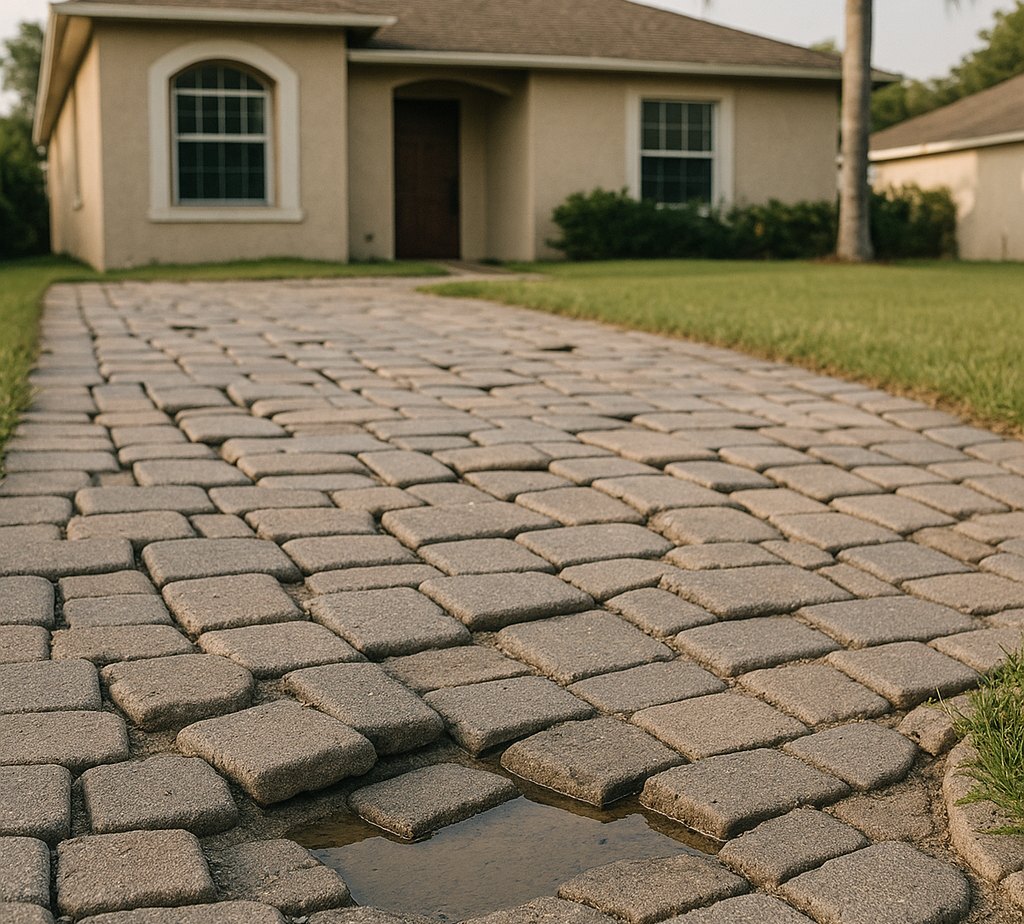
Every Saturday morning in Jacksonville, somebody pulls into Home Depot with a borrowed truck, loads up two pallets of pavers, rents a plate compactor, and drives home convinced they’re about to save eight grand. By Sunday night they’ve got a sore back, a half-finished hole in the driveway, and a creeping suspicion that this paver driveway DIY project is harder than the YouTube guy made it look. By Monday afternoon, they’re calling us. The honest truth is that a paver patio is a forgiving weekend project — a paver driveway is a different animal entirely, and the gap between the two is where most homeowners get burned.
This isn’t a sales pitch dressed up as a warning. There are plenty of hardscape projects you absolutely should DIY. A driveway just isn’t one of them in 9 out of 10 cases, and the reasons are physical, mechanical, and code-related — not marketing. Let’s get into the actual mechanics so you can decide for yourself.
Why DIY Paver Patios Work But Driveways Usually Don’t
The reason your buddy’s paver patio still looks great after five years isn’t because he’s secretly a contractor. It’s because a patio carries almost nothing. A 200-pound adult standing on a paver creates roughly a 150 lb point load distributed across both feet. A 4,000-pound SUV with a 4,500 lb wheel load on a single tire creates 30 times that pressure on whatever paver happens to be under that contact patch — and that load hits the same spot every single morning when you back out for work.
The Load Difference Changes Everything Below the Surface
Patio installation guides — including most of the ones on YouTube — call for a 4-inch compacted base. That’s fine for foot traffic. For a residential driveway in Florida sandy soil, you need 8 to 12 inches of properly graded, properly compacted base, and on softer soils closer to the river or in low-lying neighborhoods, you might need more. The depth isn’t arbitrary. It’s the only thing distributing your truck’s weight across enough subsoil that the pavers don’t punch downward over time.
Compaction Equipment Isn’t Optional at Driveway Depth
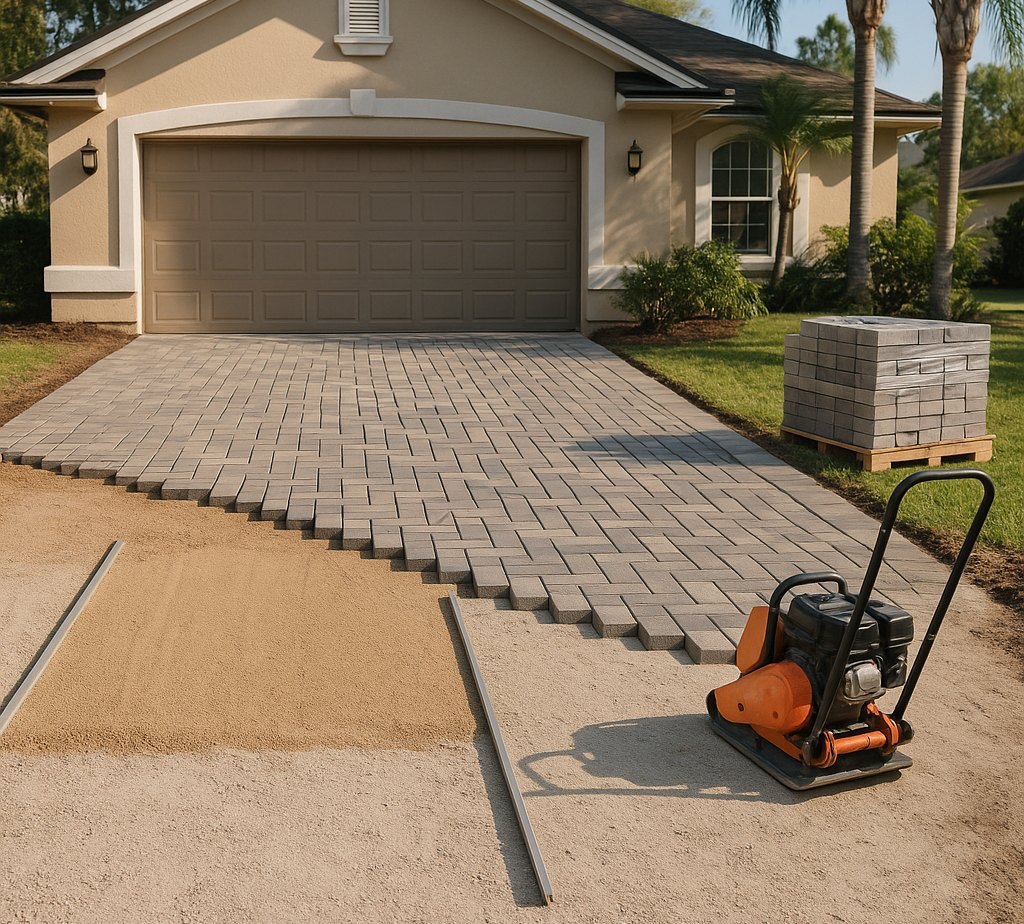
A homeowner-grade plate compactor — the 3,000-3,500 lb force units you rent for $80-150/day at the big-box stores — works fine for a 4-inch patio base. For a driveway base, you really want a reversible plate at minimum (5,000+ lb force) or a small vibratory roller, which runs $200+ per day in Jacksonville. And you need to compact in 2-inch lifts, not all 8 inches at once. A standard plate physically cannot transmit enough energy through 8 inches of crushed stone to lock the bottom layer. The base looks compacted. It isn’t.
Florida Soil Makes the Margin Thinner
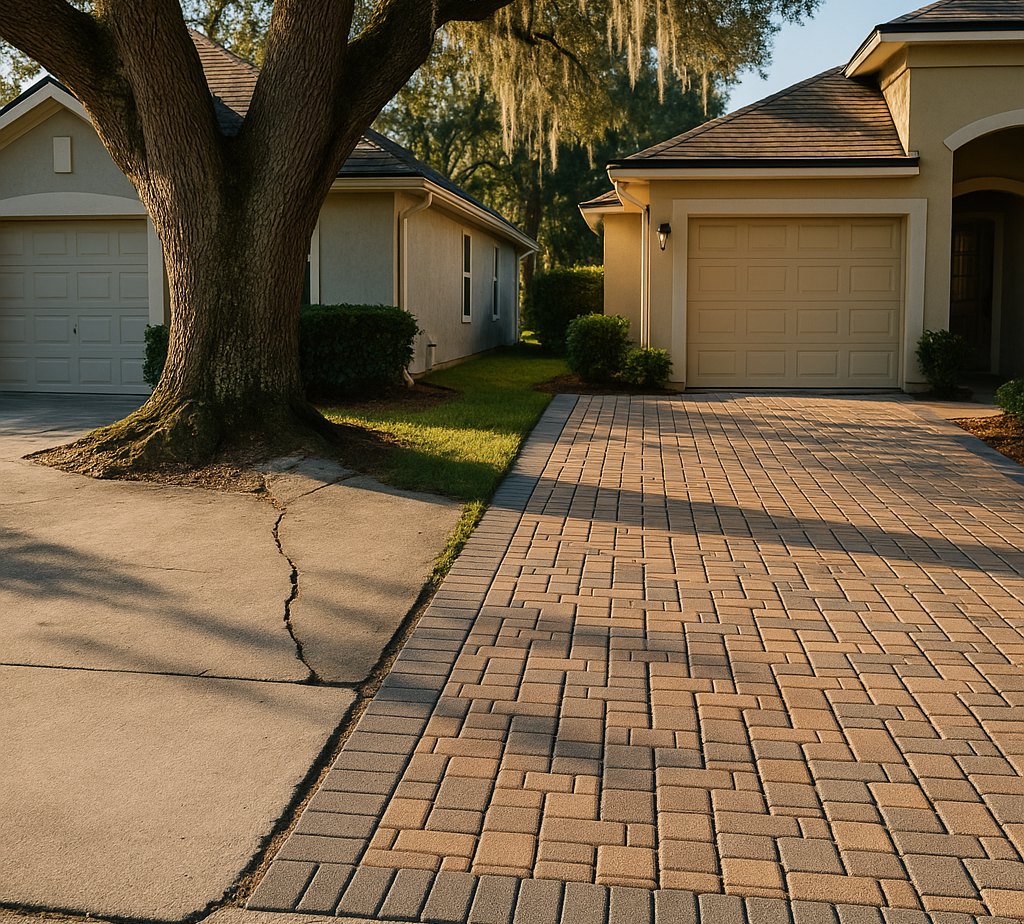
Up north, builders fight clay. Clay is annoying because it expands and contracts with moisture, but it’s structurally cohesive — it holds shape. Our Jacksonville soil is sandy and loamy, which drains beautifully but moves under load. Add our high water table, especially in older neighborhoods around Riverside, San Marco, and parts of Mandarin, and you have a substrate that punishes any base prep weakness. A driveway built on shortcut base prep up in Ohio might give you 10 years before it shows. Down here, you’ll see the first dips in 12-18 months.
The 5 Most Common DIY Paver Driveway Failures
We get called out to repair DIY driveways constantly. The failure modes are remarkably consistent. If you’re going to attempt this anyway, at least know what you’re up against.
1. Settling and Sinking After 6-12 Months
This is the big one. Tire ruts develop where you drive most often — usually right where the wheels track from the apron to the garage. The pavers themselves are fine. The base under them collapsed because it wasn’t compacted in lifts, or the wrong material was used (mason sand instead of dense-graded aggregate), or both. Repair requires lifting the entire affected area, redoing the base, and resetting every paver. It is not a patch job.
2. Edge Restraint Failure — the Paver “Spread”
Without proper edge restraint, the perimeter pavers slowly migrate outward under load. You’ll notice the edges starting to look ragged, gaps opening between the outermost rows, and eventually the whole field loosening up because once the edge moves, everything behind it loses its lateral lock. DIYers either skip edge restraint entirely or use buried 2x4s, brick edging, or landscape timbers — none of which hold up to vehicle loads.
3. Weeds and Ant Tunnels in the Joints
Standard joint sand washes out within a season or two of Florida thunderstorms. Once the joints are open, weeds sprout, fire ants tunnel underneath (they love the warm, well-drained sand bed), and water starts infiltrating the base. Polymeric sand, properly installed, is the answer — but most DIYers either skip it because of the cost or install it wrong (too much water, not enough water, sand left on paver faces during activation).
4. Pavers Shifting Under Tire Load
Running bond looks great in the showroom but it fails on driveways because there’s no interlock against directional shear force. Every time your tires brake or accelerate, the pavers want to slide. Within a year you’ll see individual stones rotated out of alignment. Pros use a 45 or 90 degree herringbone pattern specifically because it locks against shear in two directions. The DIYer who picked running bond because it was easier to lay just bought themselves a re-lay.
5. Drainage Pooling Near the Garage
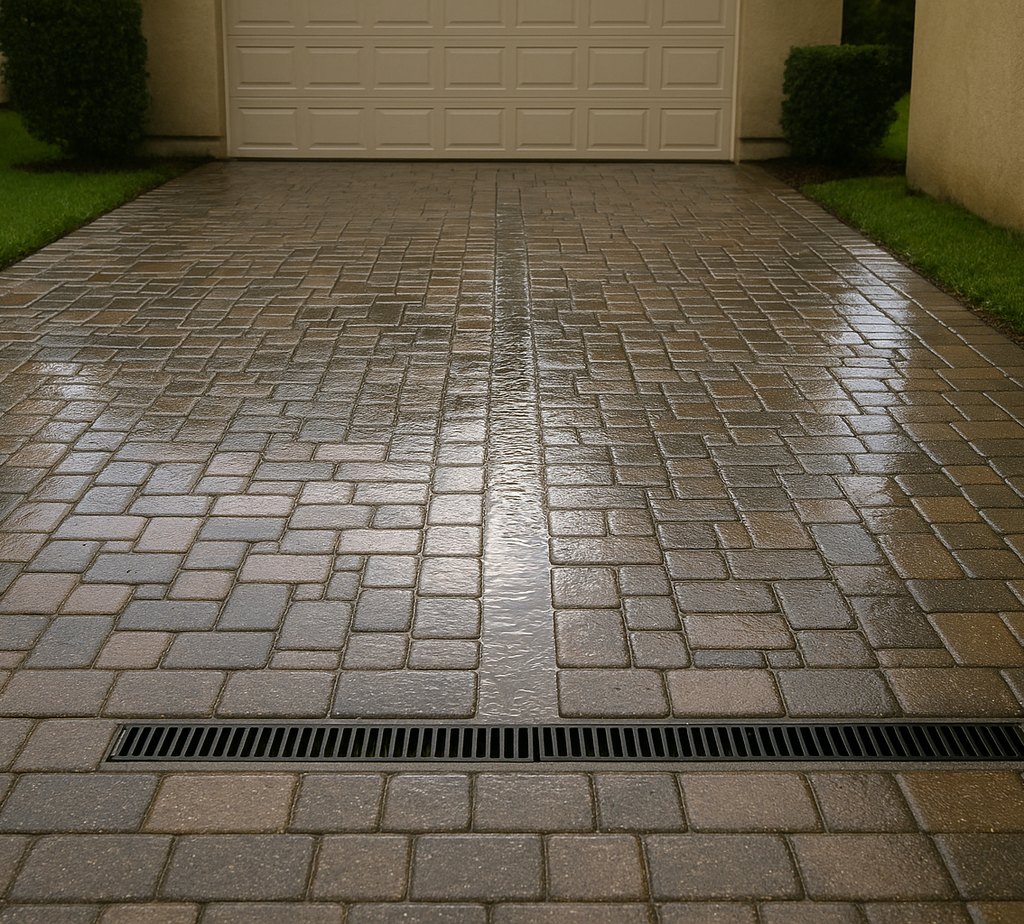
Driveways need a positive slope away from the house — typically 1/8″ to 1/4″ per foot. DIYers either don’t grade it or grade it backward because they were focused on making the surface look flat. After the first heavy rain, water pools at the garage threshold, runs into the slab joint, and starts working on your foundation. This one isn’t just expensive to fix. It’s potentially structural.
What Pros Do Differently — Base Prep
Base prep is 80% of a driveway’s lifespan. Get this right and the install is forgiving. Get it wrong and nothing you do above it matters. Here’s the actual sequence we use.
Excavation Depth
For an 800 sq ft Jacksonville driveway, we typically dig 12 inches below finished grade. That accounts for 8 inches of compacted dense-graded crushed stone, 1 inch of bedding sand, and the paver thickness (typically 2-3/8″ or 3-1/8″ for driveway-rated stones). On soft sites we’ll go deeper. We don’t guess — we probe the subsoil in multiple spots and adjust.
Geotextile Fabric
Before any base material goes in, we lay non-woven geotextile fabric across the entire excavation, lapping seams 12 inches and running it up the sides. This separates the base from the native soil so the crushed stone doesn’t slowly migrate down into our sandy subsoil. Skip this and your 8-inch base becomes 6 inches of base and 2 inches of base mixed with sand within five years. Most DIYers either skip the fabric or use the wrong type (woven landscape fabric isn’t the same thing).
Dense-Graded Aggregate in 2″ Lifts
We use #57 stone or a graded crusher run depending on the site, placed in 2-inch lifts and compacted between each lift with a Wacker Neuson reversible plate compactor — usually a WP1550 or larger. After each lift we check grade with a rotary laser level. The reason for lifts isn’t because we like extra trips with the compactor. It’s because compaction force only penetrates 2-3 inches effectively. Trying to compact 8 inches at once gives you a nice firm top and uncompacted material underneath, which is exactly the recipe for the year-2 sinking that brings homeowners to Coastal Driveway Pavers with photos of their failed DIY job.
Laser Level for Grade
Eyeballing slope on a 30-foot driveway doesn’t work. The eye normalizes any consistent slope and you’ll end up either flat or back-pitched. We set a rotary laser, mark the high and low points, and shoot grade every few feet during base placement. The cost of a contractor-grade laser is $400-800 — not insane, but not something most homeowners own.
What Pros Do Differently — Bedding and Install
Once the base is right, the bedding layer and the install pattern determine how the driveway feels and how it ages.
Concrete Sand, Not Mason Sand, Not Screenings
The 1-inch bedding layer has to be coarse enough to allow water to drain through but fine enough to set the pavers level. ASTM C-33 concrete sand is the right material. Mason sand is too fine — it holds moisture, doesn’t set firm under the paver, and contributes to settling. Limestone screenings are even worse for driveways — they pack so hard they essentially become a rigid layer that cracks under flex. Local big-box yards often substitute one for the other. Always specify by ASTM number.
Screeding the Bedding Properly
The bedding should be screeded to a consistent 1-inch depth using parallel pipe rails as guides — not eyeballed, not raked. Once screeded, you don’t walk on it. Pavers go down from a kneeling board working backward off the laid surface.
Pattern Selection for Driveway Load
For driveways, herringbone (45 or 90 degree) is the only pattern we recommend. The interlocking geometry means every paver is locked against its neighbors in two perpendicular directions, so vehicle loads can’t shear individual stones out of position. Running bond, basket weave, and stack bond all look great on patios but fail on driveways. Save the fancy patterns for the walkway.
Full Pavers at the Edges
The pavers along the perimeter should be full-size or at least two-thirds. Thin slivers at the edge — anything under about 1/3 of a paver — will pop loose under load no matter how good your edge restraint is. This means planning the field layout so cuts fall in the interior, not on the perimeter. It takes longer to plan and lay but it’s the difference between a 25-year driveway and a 5-year one.
What Pros Do Differently — Edge Restraint
Edge restraint is the single most-skipped step in DIY paver driveways. It’s also what holds the entire field together against lateral load.
Spike-Down PVC Edge
For most residential driveways we install Pave Edge or Snap Edge — rigid PVC edge restraint spiked into the compacted base with 10-inch landscape spikes every 12 inches, with extra spikes at curves. It’s invisible once backfilled with topsoil and grass, and it holds the perimeter pavers locked against outward migration.
Concrete Haunch Where Required
On apron transitions, on curved driveways, and on any edge that abuts a planting bed without lateral support, we’ll pour a small concrete haunch — basically a hidden concrete curb running under the bottom edge of the perimeter pavers, sloped away so it doesn’t show. This is overkill for a straight residential driveway interior but essential at high-stress transitions.
Why DIY Brick Edging and Buried Lumber Fail
The most common DIY edge restraint we see is a row of bricks set on edge in the soil, or a 2×4 buried along the perimeter. Both fail within a year. Bricks aren’t anchored — they tip outward as the field pushes against them. Lumber rots in our climate (especially with Florida humidity and termites) and provides no rigid restraint even when intact. Landscape timbers spiked with rebar fail the same way. There’s no shortcut here that works.
What Pros Do Differently — Compaction and Joint Sand
The last 10% of the install is what separates a driveway that ages gracefully from one that looks rough by year three.
Final Compaction With the Pavers in Place
After all pavers are laid and edge restraint installed, we run the plate compactor over the finished surface — but with a urethane mat or rubber pad attached to protect the paver faces. This seats the pavers into the bedding and locks them as a single interlocking surface. Without this step, individual pavers can sit slightly proud or low, and the surface will shift unevenly under traffic. The pad is critical — running a bare plate on pavers chips the corners and edges.
Polymeric Joint Sand, Activated Properly
Polymeric sand — Sakrete PermaSand, Techniseal NextGel, or similar — is silica sand mixed with a polymer binder. Swept into the joints dry, then activated with a controlled water mist, it sets up firm but flexible. It resists weed growth, ant infiltration, and washout from heavy rain. It also has to be installed exactly right. Too much water and you wash the polymer out and stain the paver faces with binder residue. Too little and it never activates. Sand left on paver faces during activation creates a permanent haze that’s almost impossible to remove. The Sakrete instructions are specific for a reason.
This is one of the steps where we see DIYers do everything else right and then ruin the visible finish in the last hour of the job. Our crews at Coastal Driveway Pavers have installed thousands of square feet of polymeric sand in Jacksonville’s specific humidity and temperature conditions, and even we still respect the activation window — it’s not forgiving.
The Honest Math: DIY Savings vs Hire It Out
Let’s put numbers on this for an 800 sq ft driveway, which is roughly a single-car driveway 12 feet wide by 65 feet long.
True DIY Cost
Pavers at $4-7/sq ft delivered: $3,200 to $5,600. Base material (10 yards of crushed stone delivered): $400-600. Bedding sand (3 yards): $90-150. Geotextile fabric: $80-150. Edge restraint and spikes: $150-250. Polymeric sand for the joints: $200-350. Tool rentals — plate compactor for 3 weekends, laser level, screed pipes, paver saw rental for cuts: $400-800. Disposal of excavated soil: $200-400. Add it up and you’re at roughly $4,700 to $8,300 in materials and rentals — not including any of your time, fuel hauling materials, or the inevitable second trip when you under-order pavers by 10%.
True Time Cost
Realistically, three to four full weekends of hard physical labor for two people. Pavers run 12 to 15 lbs each. An 800 sq ft driveway is roughly 1,400 to 2,000 individual stones, every one of which gets handled at least three times. That’s a lot of bending and lifting, and the back injury risk is real — we’ve talked to plenty of homeowners who pulled something serious in week 2 and had to hire out the rest anyway.
Pro Install Cost
Professional installation in the Jacksonville market runs $14-22/sq ft for residential driveway pavers, all-in. For 800 sq ft that’s $11,200 to $17,600, including excavation, base, bedding, pavers, edge restraint, polymeric sand, cleanup, hauling, and a 25-year materials and labor warranty.
The Math That Actually Matters
Looks like DIY saves you $6,000-9,000, right? Here’s the catch. The failure rate on DIY paver driveways inside three years runs north of 60% in our market based on the call volume we see. When the DIY job fails — settling, edge spread, drainage failure — the repair isn’t a patch. It’s a full tear-out and reinstall, because you can’t fix a base from the top down. So you spent your $5,000 on materials, three weekends of weekends, and then spent $14,000-17,000 on the pro install anyway. Total damage: roughly $20,000 plus the value of those weekends. The honest savings only materialize if your DIY job actually lasts 20+ years, and the data on that isn’t kind.
When DIY Actually Makes Sense
None of this means hardscape is off-limits to homeowners. We’re DIY-positive in spirit. There are absolutely projects where rolling up your sleeves makes total sense.
Walkways Under 100 Square Feet
Foot-traffic only walkways, garden paths, side-yard connectors — these are textbook DIY projects. The 4-inch base depth is achievable with a homeowner plate compactor, the load is low, and even modest mistakes are forgiving. Same install techniques apply (geotextile, screeded sand bedding, polymeric joint sand) but the consequences of imperfect execution are cosmetic, not structural.
Patio Extensions and Garden Borders
Adding a 100-200 sq ft patio off the back slab, building a paver border around a planting bed, creating a small fire-pit pad — all great DIY projects. You’ll learn the techniques, develop the muscle memory, and end up with results you can be proud of. None of these projects involve vehicle loads, so the base prep and edge restraint forgiveness is much higher.
Where the Line Is
The line is vehicle weight. The moment a tire is going to roll across what you’re building, the requirements jump dramatically — base depth, compaction equipment, pattern selection, edge restraint — and the failure consequences jump with them. If you want to learn pavers, build a beautiful walkway and patio. Then when it’s time for the driveway, hire someone who’s done it 500 times.
Frequently Asked Questions
Can I install a paver driveway myself?
Technically yes, practically rarely worth it. The skills are learnable but the equipment requirements (reversible plate compactor or vibratory roller, laser level, paver saw, proper screed setup) and the physical demands of moving 1,500+ pavers across 3-4 weekends mean most homeowners either don’t finish or don’t finish well. The failure rate on DIY paver driveways within 3 years in the Jacksonville market is high enough that most homeowners end up paying for a pro install on top of their DIY costs. Walkways and patios DIY beautifully — driveways usually don’t.
How deep does the base need to be for a paver driveway?
For a residential driveway in Jacksonville’s sandy soil, you need 8 to 12 inches of compacted dense-graded crushed stone base, plus 1 inch of concrete sand bedding, plus the paver thickness (usually 2-3/8″ to 3-1/8″ for driveway-rated pavers). Total excavation depth is typically 12 inches below finished grade. The base must be installed and compacted in 2-inch lifts — not placed all at once — because plate compactors can only effectively transmit force through 2-3 inches of material at a time. Skipping the lift method is the single biggest cause of DIY driveway settling.
What tools do I need to install pavers?
For a driveway-grade install: reversible plate compactor (rental $100-200/day) or small vibratory roller, rotary laser level, paver saw or wet tile saw with diamond blade for cuts, screed pipes and a long screed board, rubber mallet, masonry chisel, level, string lines, wheelbarrow, shovels, and a sand applicator for polymeric sand. You’ll also need transportation for several tons of base material and pavers. For a small walkway, you can get away with a homeowner plate compactor and basic hand tools, but a driveway needs the contractor-grade equipment to hit proper compaction.
Do I need a permit to install my own driveway in Jacksonville?
For the portion of the driveway on your private property, Duval County typically does not require a permit for paver replacement of an existing driveway. However, any work in the public right-of-way — which includes the apron between the sidewalk and the street — requires a permit and must be performed by a licensed contractor. If you’re extending a driveway, changing its dimensions, or installing in a planned-unit development with HOA architectural review, additional approvals usually apply. Always check with the City of Jacksonville Building Inspection Division before starting work, because permit violations on the apron can result in tear-out orders.
How much can I really save by DIY-ing a paver driveway?
On paper, the DIY route on an 800 sq ft driveway saves $6,000-9,000 compared to professional installation ($4,700-8,300 in DIY materials and rentals vs $11,200-17,600 pro install). In practice, those savings only materialize if your install lasts 15-20+ years. When the DIY job fails inside 3 years — which is the more common outcome — you tear out the failed install and pay the full professional price anyway, putting your total cost north of $20,000. The honest savings depend entirely on the quality of your execution, and execution at driveway-grade is where most DIYers fall short. For walkways and patios, the math is much friendlier to DIY because the consequences of imperfect execution are cosmetic rather than structural.