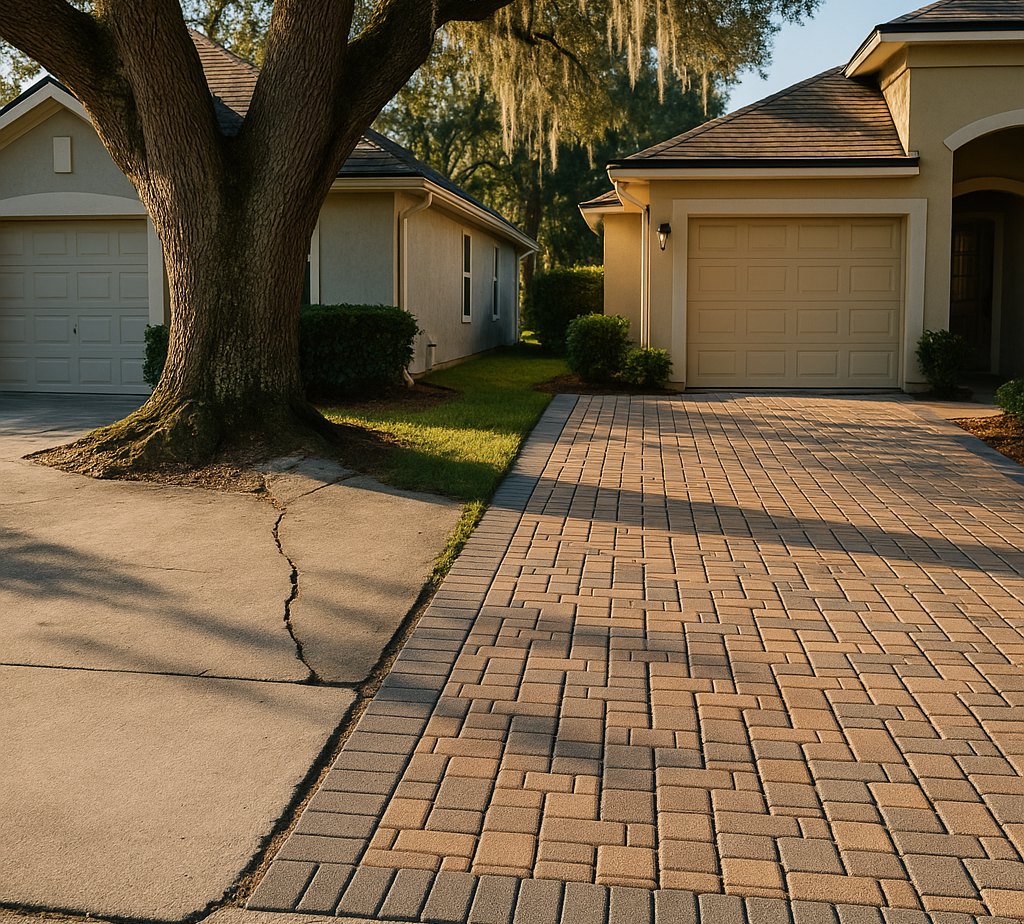
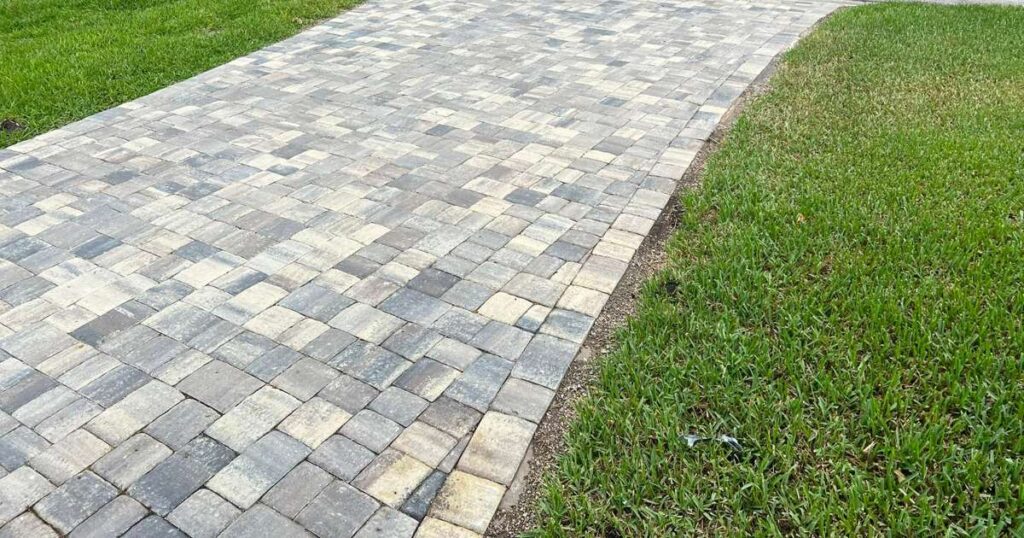
Your driveway does not actually begin at your garage. It begins at the edge of the public street, where the asphalt or concrete of the roadway hands off to your private drive. That transition strip is the driveway apron, and in Jacksonville it is the single most abused, most misunderstood, and most frequently permitted section of any residential driveway. It carries the full turning weight of every vehicle that enters your property, it usually sits inside the public right-of-way, and it is governed by rules most homeowners never knew existed until an inspector or a code officer brought them up.
If you are replacing a cracked concrete apron with brick pavers, extending a drive in Nocatee or Mandarin, or fixing a section that has already started to sink, this is the part of the project where the City of Jacksonville (COJ) and sometimes FDOT get a say. Getting the apron right is part engineering and part paperwork, and both halves matter in Duval, St. Johns, Clay, and Nassau counties.
This guide walks through what a driveway apron is, why aprons fail in Northeast Florida specifically, how permits and right-of-way rules work here, and which paver types and base builds actually hold up under the load.
What a driveway apron actually is
A driveway apron is the flared section of pavement that connects the public roadway to your private driveway. It typically spans from the edge of the street (or the gutter pan, if your street has curb and gutter) across the swale or grass strip to your property line. In older Jacksonville neighborhoods like Riverside, Avondale, and Springfield, the apron often ties directly into an existing sidewalk. In newer master-planned communities like Nocatee and eTown, it may cross a drainage swale before it reaches your lot.
Two things make the apron different from the rest of your driveway. First, it almost always sits in the public right-of-way rather than on your private property, which is why the city regulates it. Second, it takes the hardest mechanical beating of any section, because vehicles turn, brake, and accelerate across it every single day. That combination is exactly why a brick paver driveway apron that was built to residential-interior standards tends to fail early.
Deep dive: apron vs. driveway vs. curb cut
These three terms get used interchangeably, but they are distinct. The curb cut is the depressed section of curb that allows vehicles to roll off the street. The apron is the paved transition between that curb cut (or street edge) and your driveway. The driveway proper is everything on your private property. COJ permitting language often refers to the apron and curb cut together as the “driveway connection,” and the connection is what the right-of-way permit actually authorizes. Your interior driveway usually needs no city permit at all; the connection almost always does.
Why the apron sits in the public right-of-way
The public right-of-way (often shortened to ROW or PROW) is the strip of land the city or state controls for streets, sidewalks, utilities, and drainage. It usually extends several feet beyond the visible edge of the pavement, which means the grass swale in front of your house, the sidewalk, and your driveway apron frequently sit on public land even though you mow and maintain them.
Because the apron occupies that public strip, you cannot simply rebuild it however you like. Work in the right of way requires a permit, has to preserve drainage flow through the swale, and must keep any sidewalk continuous and ADA-compliant. On a state-maintained road, that authority belongs to FDOT rather than COJ, which changes the process entirely.
- City-maintained streets (most residential roads in Duval): the driveway connection permit runs through COJ Public Works / Right-of-Way.
- State roads (US-1, Blanding Blvd, Beach Blvd, Atlantic Blvd, portions of SR-13): a connection or driveway permit goes through the FDOT District Two office in Lake City / Jacksonville.
- Private communities (many gated Nocatee and Ponte Vedra villages): the HOA or CDD may control the ROW, adding an architectural review layer on top of county rules.
Why driveway aprons crack and sink in Northeast Florida
Aprons fail for reasons that are amplified by our local conditions. The three big culprits are traffic load, a weak base, and drainage, and Jacksonville stacks all three against you.
Traffic load. Every vehicle entering your driveway pivots across the apron. Add a lifted truck, a boat trailer common along the St. Johns and Intracoastal, or a delivery van, and the point loading at the apron is far higher than anywhere on the interior drive. A base built for foot traffic and passenger cars will rut and dip under that turning stress.
Weak or thin base. Much of Northeast Florida sits on fine sandy soils that drain fast but offer little cohesive strength. On top of that, older aprons were often poured or set on four inches of loose sand with no compacted aggregate underneath. Under repeated turning load, that sub-base migrates and the surface follows it down.
Drainage and the water table. Coastal Duval, Nassau Beach communities, and low-lying parts of St. Johns have a seasonally high water table. During summer thunderstorm season and named-storm rain events, saturated ground loses bearing capacity. Water moving through the swale also undermines apron edges. If you have already watched a section drop, our breakdown of why paver driveways sink in Jacksonville covers the base-and-water mechanics in detail.
Deep dive: how a high water table steals bearing capacity
Compacted aggregate gets its strength from particle interlock and friction. When groundwater rises into the base layer, water pressure between particles reduces the effective stress holding them together, so the same load that was fine in the dry season can push the base out of shape after a week of summer rain. This is why aprons in Fernandina Beach, Atlantic Beach, and riverfront San Marco lots frequently need a thicker, better-drained base than a comparable lot in higher, drier Mandarin. Building the base above the seasonal high water table, with open-graded stone that drains, is the fix, not simply adding more sand.
Best paver types for a driveway apron
Not every paver belongs in an apron. Because the apron sees turning load and sits where the city may inspect it, thickness, shape, and interlock all matter more here than on a patio or walkway. These are the paver families worth considering for driveway apron pavers in our market.
| Paver type | Typical thickness | Apron suitability | NE Florida notes |
|---|---|---|---|
| Concrete interlocking pavers | 60 mm (2.4 in) driveway grade | Excellent | Best all-round choice; dense interlocking shapes resist turning shear. Use driveway-rated, not 45 mm patio units. |
| Clay brick pavers | 2.25–2.75 in | Very good | Classic look for Avondale, Ortega, and Springfield; color runs through the unit so scuffs do not show. Verify it is a paving brick, not a wall brick. |
| Permeable pavers | 80 mm (3.1 in) | Good, situational | Open joints handle swale drainage and can satisfy stormwater goals; needs an open-graded stone reservoir and periodic joint cleaning. |
| Large-format concrete slabs | Varies | Poor for aprons | Big rigid units crack under point loads at the street transition; better kept on interior patios. |
For most Jacksonville homes we specify a driveway-rated 60 mm interlocking concrete paver or a true 2.25 inch clay paving brick. Both develop their strength through joint interlock, so a large field of small units shares the load rather than concentrating it. Herringbone at 45 or 90 degrees is the strongest laying pattern for the turning stress an apron sees and is what we default to at the street edge.
The base build that makes an apron last
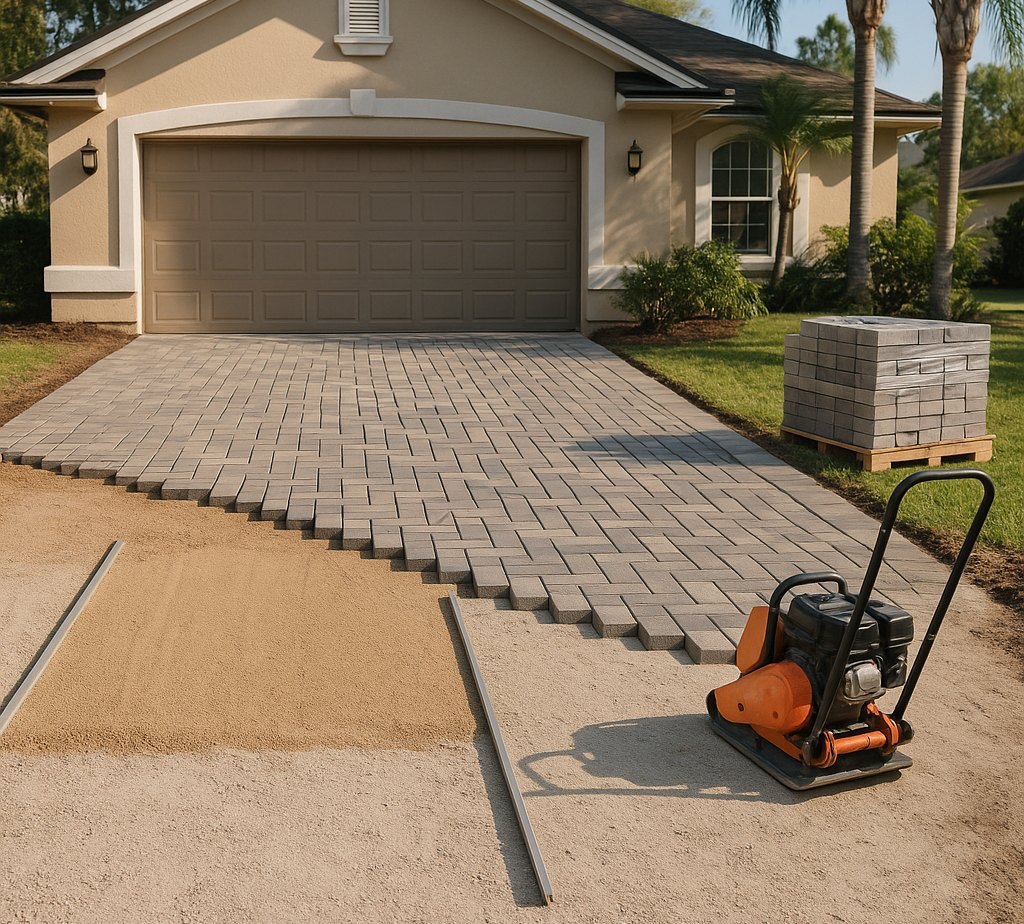
The visible pavers are the least important part of a durable apron. What holds up under a decade of turning trucks is the structure underneath. A proper driveway apron in our soils is built as a system, from the subgrade up.
- Excavation to depth. Dig deeper than you would for a walkway. We typically over-excavate so the finished base can be substantially thicker at the apron than on the interior drive.
- Compacted aggregate base. Six to eight or more inches of crushed limerock or graded aggregate, placed and compacted in lifts of a few inches at a time. Compacting in lifts is what prevents the future dip.
- Edge restraint. A concrete toe or heavy-duty spiked edge locks the perimeter so the field cannot spread outward under braking and turning loads. This is the detail cut-rate installers skip, and it is the reason edges fail first.
- Bedding and joint sand. A thin bedding layer of coarse sand, then polymeric jointing sand swept into the joints and activated so the field behaves as one interlocked mass.
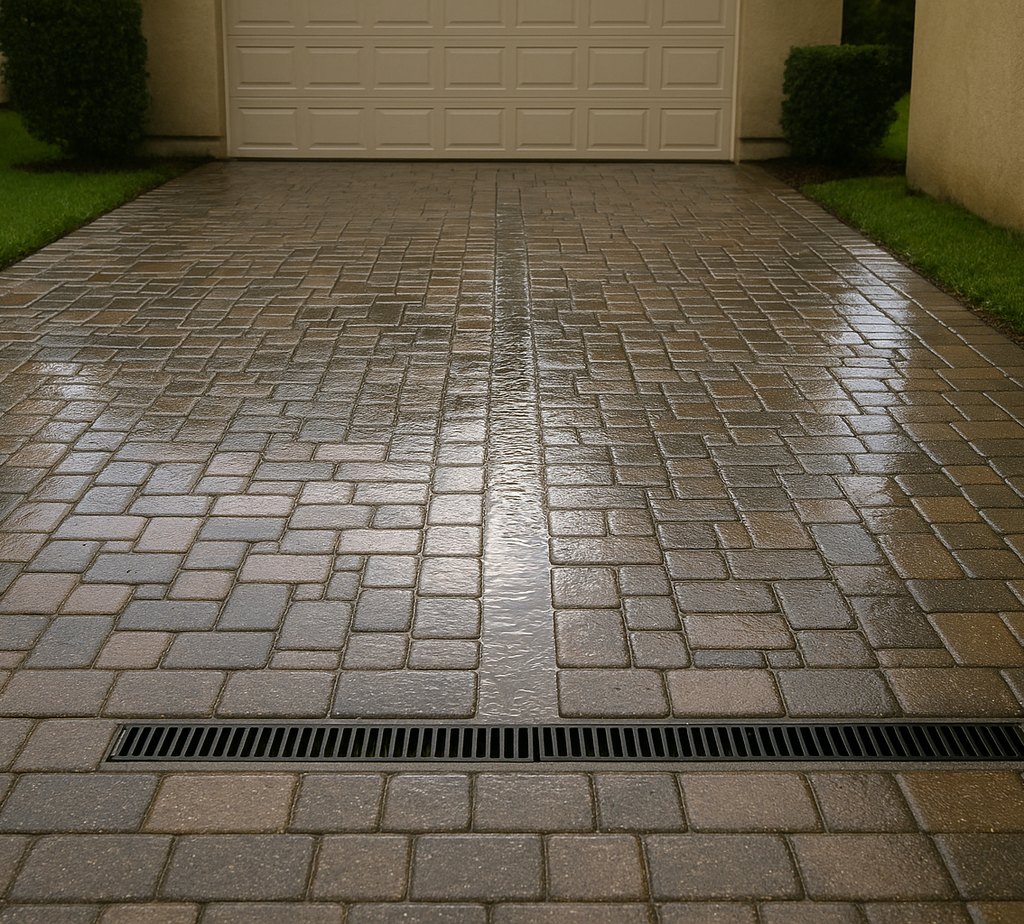
- Positive drainage. The apron has to shed water toward the swale and never trap it against the pavers. Slope and elevation are set so runoff follows the street’s existing gutter and swale flow, which is also what the ROW inspector checks.
Deep dive: why lift-by-lift compaction matters more here
When crushed base is dumped and compacted all at once, only the top few inches actually densify; the material below stays loose. Under an apron carrying turning trucks, that loose lower layer consolidates slowly over months, and the surface telegraphs every bit of that settlement as ruts and dips. Placing the base in thin lifts and compacting each one produces uniform density top to bottom. In sandy Duval and Nassau subgrades, where there is little natural cohesion to help, this discipline is the difference between an apron that stays flat and one that needs a call-back within two rainy seasons.
ADA, sidewalks, and keeping the walk continuous
Where a sidewalk crosses your driveway, the apron has to keep that walkway continuous, firm, stable, slip-resistant, and within ADA cross-slope limits. This is not optional in the right-of-way. An inspector will look for a pedestrian path that maintains its grade across your driveway connection without a lip, a trip edge, or an excessive cross-slope.
Pavers actually make this easier when they are set correctly, because you can fine-tune elevation unit by unit to hold the sidewalk’s line. Done poorly, though, a paver apron that settles even slightly at the sidewalk creates exactly the trip hazard the rules exist to prevent. Continuity through the walk is one of the first things COJ checks at inspection, and it is a common reason a rushed job fails and has to be reset.
The permit and inspection path in Jacksonville
Because the apron sits in the right-of-way, replacing or building one is a permitted activity in most of Duval County. The general path looks like this, though the exact steps vary by jurisdiction and whether the road is city or state maintained.
- Confirm jurisdiction. Determine whether the fronting road is COJ-maintained or an FDOT state road. This decides which agency issues the permit.
- Right-of-way / driveway connection permit. Submit a site sketch showing the connection width, materials, drainage, and how the sidewalk (if any) stays continuous. COJ Right-of-Way handles city streets; FDOT District Two handles state roads.
- HOA / CDD or ARB approval. In Nocatee, Ponte Vedra, Fleming Island, and many gated communities, architectural review runs parallel to the county permit and can dictate color and material.
- Build to the approved detail. The apron is constructed to the width, slope, and drainage shown on the approved plan.
- Inspection. The city or state inspects the finished connection for drainage, sidewalk continuity, and conformance before the permit is closed.
None of this is a reason to avoid pavers. It is a reason to work with a contractor who has actually pulled these permits in Duval and dealt with FDOT District Two, because a plan that ignores swale drainage or sidewalk grade gets kicked back, and a rebuild in the right-of-way is not where you want a surprise.
Why a contractor who knows COJ right-of-way matters
A driveway apron is one of the few home projects where a beautiful surface can still fail inspection or fail structurally within two years if the base, drainage, and paperwork are wrong. The installers who get called back for a sunken brick paver driveway apron are usually the ones who treated the apron like a patio, skipped the right-of-way permit, or ignored how water moves through the swale.
A contractor who works in Duval, St. Johns, Clay, and Nassau every week already knows which roads are FDOT, how COJ reviews a driveway connection, why Fernandina and the beaches need a taller base than Mandarin, and how to keep a sidewalk ADA-continuous across the drive. That local knowledge is what turns a driveway apron replacement into a one-and-done project instead of a recurring headache. Once it is built right, keeping it looking sharp is simple, and our guide to cleaning a paver driveway in Jacksonville walks through the safe way to do it.
Frequently Asked Questions
Do I need a permit to replace my driveway apron in Jacksonville?
In most cases, yes. The apron sits in the public right-of-way, so replacing or rebuilding the driveway connection typically requires a right-of-way permit from the City of Jacksonville, or a driveway connection permit from FDOT District Two if your home fronts a state-maintained road. Your interior driveway usually does not need a city permit, but the apron connection almost always does.
What is the difference between a driveway apron and the driveway itself?
The apron is the flared transition section between the public street and your private driveway, usually sitting inside the public right-of-way. The driveway proper is everything on your own property. The apron takes the hardest turning and braking loads and is the part the city regulates, which is why it needs a stronger base and, often, a permit.
Are brick pavers a good choice for a driveway apron?
Yes, when you use a true driveway-rated paving unit. A 60 mm interlocking concrete paver or a 2.25 inch clay paving brick, laid in a herringbone pattern over a properly compacted base with edge restraint, handles apron turning loads well. Avoid thin patio pavers and large rigid slabs, which crack or rut at the street transition.
Why does my driveway apron keep sinking?
Almost always a base and drainage problem, amplified by Northeast Florida’s sandy soils and high water table. Turning vehicle loads consolidate a thin or poorly compacted base, and rising groundwater during the rainy season reduces its bearing strength. The lasting fix is over-excavating, building a thicker base compacted in lifts, adding edge restraint, and ensuring positive drainage to the swale.
Does my driveway apron have to keep the sidewalk ADA-compliant?
Yes. Where a sidewalk crosses your driveway, the apron must keep the walkway continuous, firm, stable, and within ADA cross-slope limits, with no trip edge. Because this is in the right-of-way, the City of Jacksonville checks sidewalk continuity and grade at inspection, and a settled or lipped paver edge is a common reason a job fails and has to be reset.