Pavers vs concrete is the first decision on almost every driveway we quote in Jacksonville, and it is usually framed as a question of looks. It is really a question of how each one handles the ground underneath it.
Both can last for decades. Both can also fail early. In Northeast Florida, the difference between a paver driveway and a concrete driveway comes down to how each surface copes with sandy soil, a high water table, live oak roots, heavy vehicles and a summer of storms, and what a repair looks like when something finally moves.
The short version. A concrete driveway is one rigid slab: strong, smooth and simple, but when the ground under it shifts it cracks, and the repair always shows. A paver driveway is thousands of interlocking units on a compacted base: it flexes with the ground, and any section that settles or gets damaged can be lifted and relaid so the repair disappears. Built on a proper base, a paver driveway is the one more likely to still look right after twenty years in Northeast Florida. Concrete makes sense when the ground is stable, there are no big trees nearby and you are comfortable with control joint cracks over time.
How each driveway is built
Most of the difference in durability comes from what is underneath.
- Concrete. The ground is graded and compacted, forms are set and concrete is placed as a single slab, typically about four inches thick for passenger cars and thicker where heavier vehicles park, with reinforcement and control joints cut to decide where the inevitable cracks will go. Our concrete work starts with the same grading and compaction.
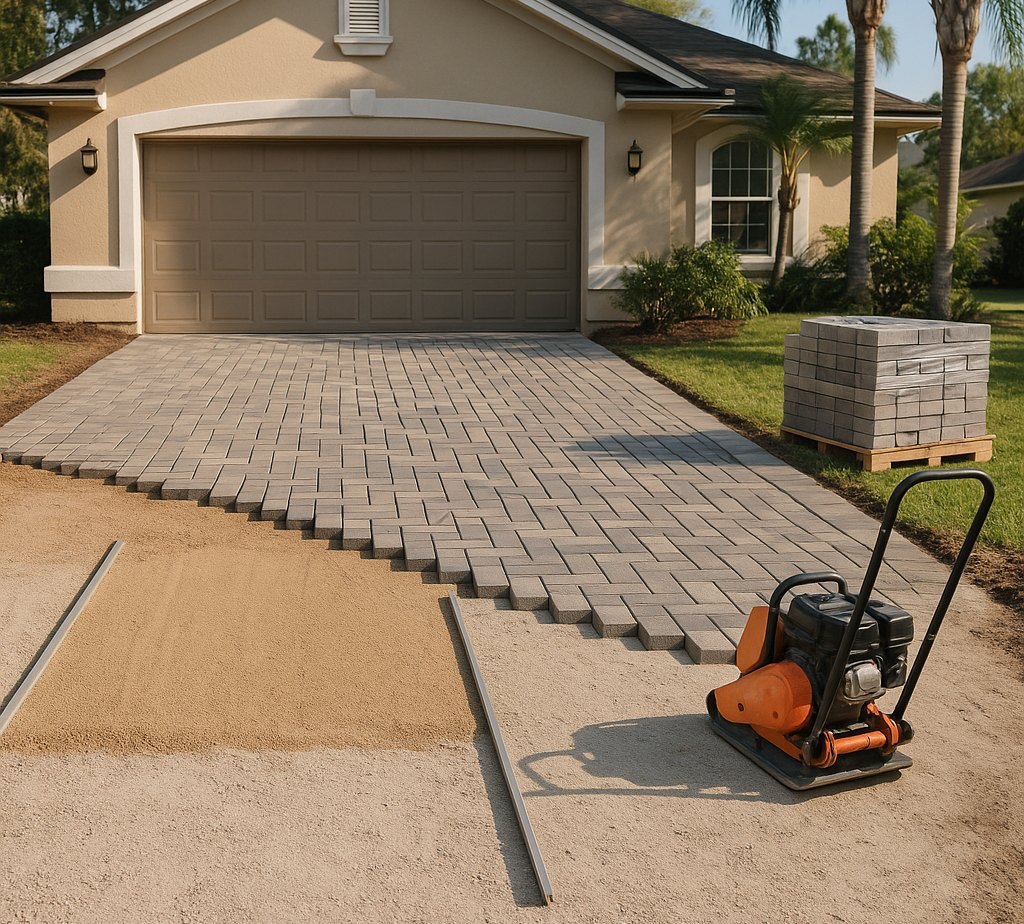
- Pavers. The soil is excavated deeper, then 6 to 8 inches of compacted limerock or crushed aggregate base goes in, about an inch of bedding sand on top, vehicle-rated pavers in an interlocking pattern, an edge restraint to lock everything in place and sand in the joints. The base carries the load; the pavers spread it.
Industry guidance from the Concrete Masonry & Hardscapes Association, which now includes the former Interlocking Concrete Pavement Institute, centers on exactly those layers: a compacted base, a thin bedding sand layer, interlocking pavers and edge restraints. Our step-by-step guide to paver driveway installation walks through each layer, and what happens under your pavers explains why the base matters most.
How pavers and concrete handle Northeast Florida conditions
- Sandy soil and settlement. Much of the area sits on sandy soil with a high water table. When water washes sand out from under a slab or the ground settles, concrete loses support and cracks. Pavers settle too if the base is poor, but a settled area can be lifted, re-based and relaid.
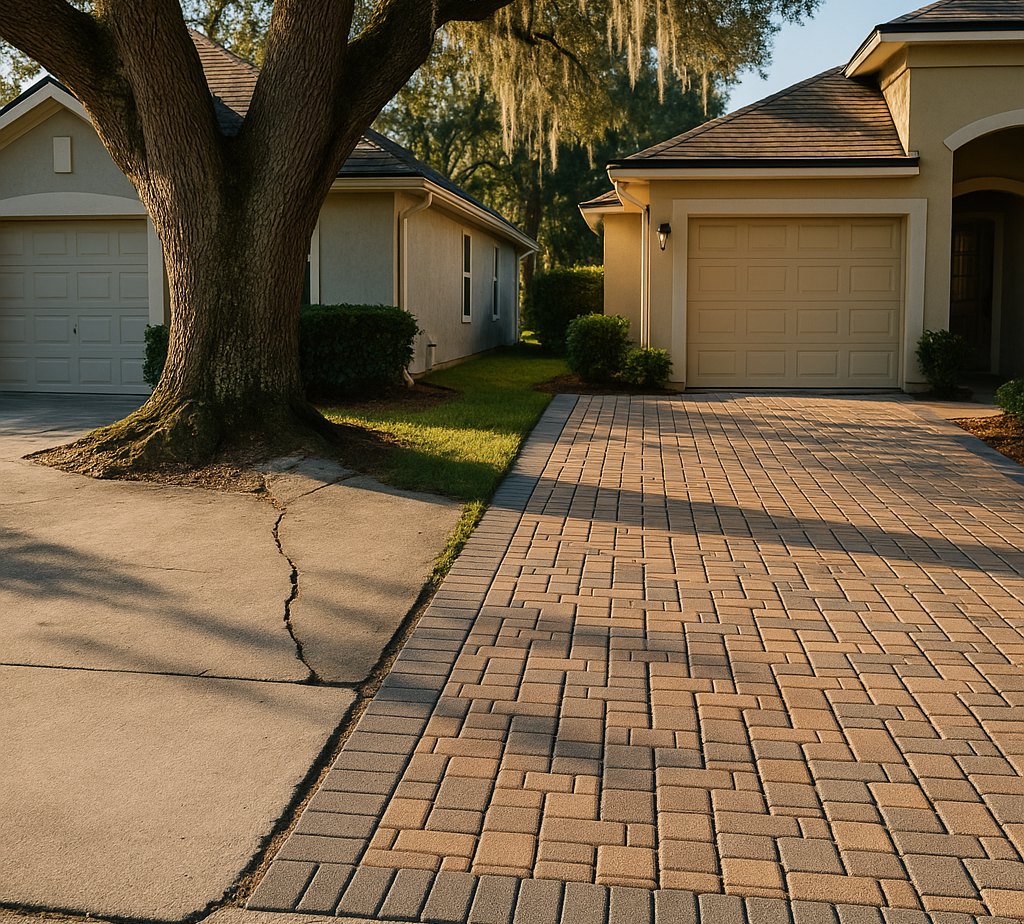
- Live oak roots. Roots lift whatever is above them. Under concrete that means a cracked, heaved slab and a trip edge. Under pavers it means a bump that can be lifted, the root dealt with and the pavers reset.
- Heavy vehicles. Delivery trucks, RVs, boats and work trucks concentrate weight at the tires. A thicker concrete slab handles it if the ground beneath is good. Interlocking pavers on a deep base handle it well because the load spreads through the pattern, which is why herringbone is the standard for driveways.
- Heat and sun. Concrete expands in summer heat, one reason control joints matter so much. Pavers have joints everywhere, so expansion is never an issue. Both can fade over time, and color choice affects how hot either one gets.
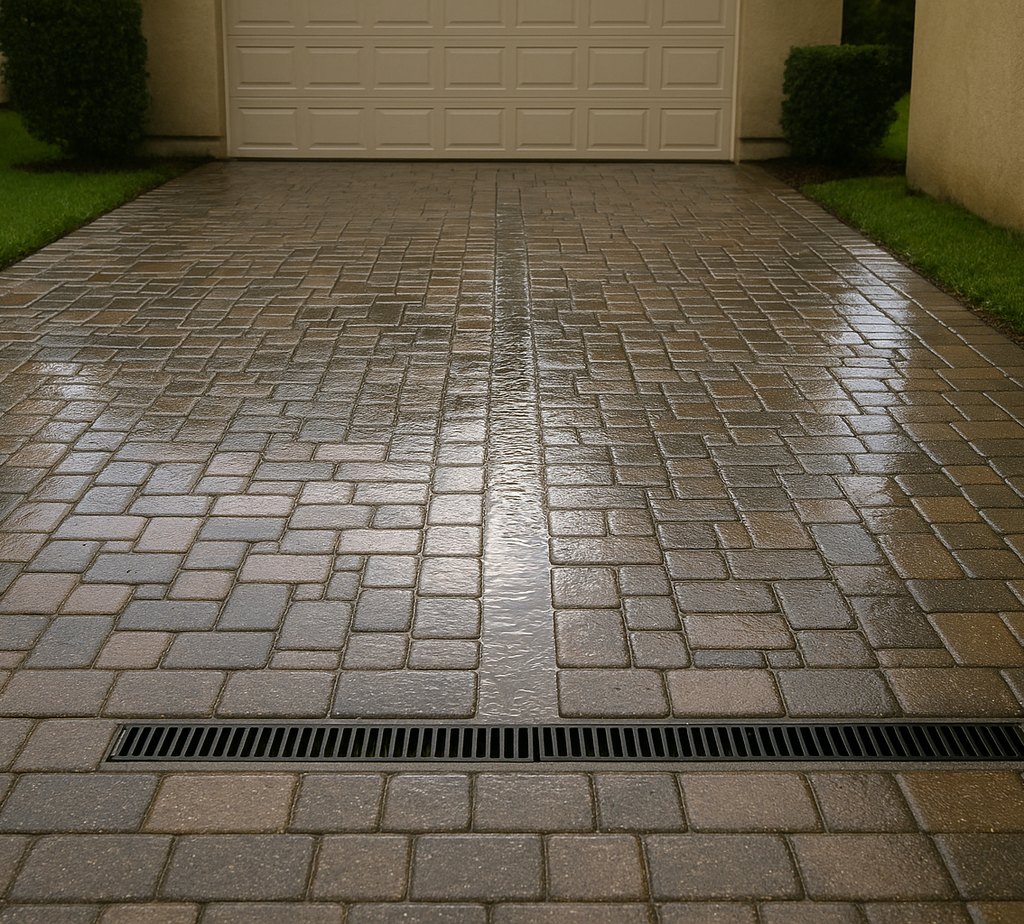
- Rain and storms. Neither standard concrete nor standard pavers let water through, so both depend on slope. A driveway should shed water away from the garage and the house. Our guide to driveway drainage covers how.
Cracks, stains and repairs: what each looks like years later
This is where the two really part ways.
Concrete will crack. Control joints are cut so that most cracks follow them, but random cracks still appear as the slab ages, the ground moves or roots grow. Repairs are possible, from sealing a crack to resurfacing or replacing a section, but new concrete never quite matches old concrete, so a repaired slab tends to look repaired. If yours is already cracking, our guide to reading concrete driveway cracks explains which ones matter.
Pavers do not crack the way a slab does. When an area sinks, a paver chips or a utility line has to be dug up, the pavers in that area are pulled, the base is corrected and the same pavers go back down. Done properly, you cannot tell where the work was. Oil stains are easier too, since a badly stained paver can simply be replaced. The trade-off is the joints: they need sand, they can grow weeds or host ants if neglected, and a sunken spot needs attention before it spreads. See why paver driveways sink for the usual causes.
Pavers vs concrete driveway at a glance
| Factor | Concrete driveway | Paver driveway |
|---|---|---|
| Structure | One rigid slab | Interlocking units on a compacted base |
| When the ground moves | Cracks | Flexes and can be reset |
| Repairs | Visible patches or replaced sections | Lift, re-base and relay the same pavers |
| Heavy vehicles | Good on a thick slab and stable ground | Good on a deep base in an interlocking pattern |
| Tree roots | Heaved, cracked slabs | Bumps that can be lifted and reset |
| Stains | Permanent once set in | Individual pavers can be replaced |
| Routine upkeep | Cleaning, sealing cracks and joints | Cleaning, topping up joint sand, optional sealing |
| Design options | Broom, stamped or colored finishes | Wide range of colors, shapes, patterns and borders |
| Long-term look | Gradually shows cracks and patches | Stays uniform if maintained |
Maintenance over the years
- Concrete: keep it clean, seal cracks before water gets under the slab, and keep heavy equipment off the edges, which have the least support.
- Pavers: keep the joints full, rinse and clean as needed, and fix a sunken spot early. Sealing is optional but helps hold joint sand and resist stains. Our guides to polymeric sand and driveway sealing cover both.
Which one fits your driveway?
Weighing the concrete driveway pros and cons against pavers comes down to your site. Choose concrete if you want a smooth, simple surface, your soil is stable, there are no big trees near the driveway and keeping the upfront investment down matters most. A well-built slab can serve for a long time.
Choose pavers if there are live oaks nearby, the soil is soft or the area holds water, heavy vehicles use the driveway, or you want a driveway that can be repaired invisibly and still look new in twenty years.
If you like the look of pavers but are leaning toward concrete, read our comparison of pavers and stamped concrete before you decide.
Questions to ask before you sign
- How deep will the base be, and what material is it?
- How will the ground be compacted, and in how many layers?
- For concrete: how thick is the slab, what reinforcement is used and where will the control joints go?
- For pavers: are they rated for vehicle traffic, what pattern will be used and how are the edges restrained?
- Where will the water go?
- What does the warranty cover, and for how long?
Frequently asked questions
Do pavers last longer than concrete?
What are the downsides of pavers?
Is a concrete driveway worth it?
What is the best paving for driveways in Florida?
Can you put pavers over an existing concrete driveway?
Get a straight answer for your driveway
The right choice depends on your soil, your trees, what you park and how long you plan to stay. We will walk the driveway with you, check the slope and the ground, and tell you honestly whether pavers or concrete makes more sense. See how we work on our driveway installation page.
Replacing an old, cracked slab? Our driveway replacement page covers what is involved.