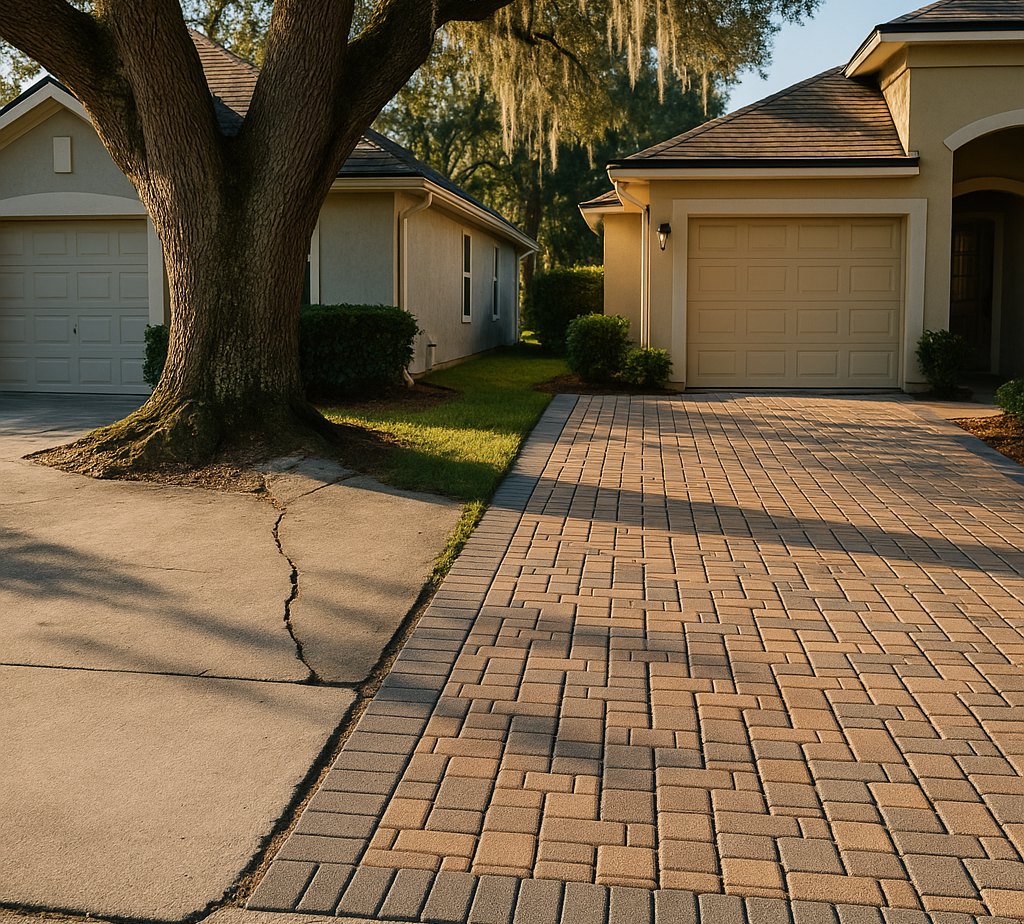
You back out of the garage the same way you have for years, and one morning you notice it: a dip in the wheel track that never used to be there, or a low spot near the apron that holds a puddle long after a Jacksonville afternoon thunderstorm has moved on. Maybe a single paver near the middle of the drive has dropped a half inch below its neighbors and clicks under your tire every time you roll over it. A sinking paver driveway is one of the most common calls we get from homeowners across Duval County, and almost every time, the problem is not the pavers themselves. It is what is happening underneath them.
Here is the good news up front: a paver driveway that is settling in Jacksonville is usually fixable, and in the vast majority of cases you do not need to tear the whole thing out and start over. Because pavers interlock rather than pour as one rigid slab, a trained crew can lift the failed area, fix the base and bedding that caused the sinking, and reset the same pavers flush — leaving the rest of your driveway untouched. But that only works if the real cause is diagnosed correctly first.
In this guide we will walk through exactly why paver driveways sink in Jacksonville, FL — from our loose sandy soil and high water table to washed-out base material, tree roots, and heavy vehicle loads — how a professional diagnoses the true cause before touching a single paver, and how a proper re-level is done so the fix actually lasts. You will finish knowing whether you are looking at a quick spot repair or something that needs the base and drainage corrected first.
The Telltale Signs: Sinking, Ruts, and Low Spots That Hold Water
Paver settling rarely shows up all at once. It creeps in, and it tends to announce itself in one of three distinct patterns. Learning to read which one you have tells you a lot about what is going wrong beneath the surface.
- Isolated sunken pavers. One paver — or a small cluster — sits noticeably lower than the field around it. It may rock underfoot or click under a tire. This usually points to a localized void in the bedding sand or a soft pocket in the base directly below that spot.
- Parallel wheel-track ruts. Two channels of depression running the length of your driveway, lined up with where your tires travel, often deepest at the garage entry and the apron. Ruts are a classic sign that the base was never compacted tightly enough and has consolidated under repeated vehicle weight.
- Broad low spots that puddle after rain. A wide, shallow saucer that collects water and holds it for hours after a Florida downpour. This is the pattern that should worry you most, because standing water usually means the base beneath has been eroded or washed out.
That last one deserves emphasis. A properly built paver driveway is graded to shed water — you want roughly a quarter inch of fall per foot so rain runs off quickly. When a dip holds water for hours, it means the surface has dropped below the surrounding grade and water now has a place to sit and keep working on the base underneath. Standing water is not just a cosmetic annoyance in Jacksonville’s climate; it is a red flag that the foundation is actively being undermined. Every rain event that puddles there is washing more fines out of the base and deepening the problem.
So how do you tell a cosmetic wobble from a structural failure? Press on a suspect paver. If it rocks but the pavers immediately around it are solid and level, you are likely dealing with a few loose units and a shallow bedding issue — the kind of thing that is straightforward to reset. But if you see a spreading depression, ruts that keep getting deeper, multiple pavers dropping together, or a low spot that reliably ponds, you are looking at structural settling. The foundation under that section is failing, and sweeping in a little joint sand will not touch the actual cause.
How Jacksonville’s Sandy Soil and High Water Table Set the Stage
To understand why driveways sink here, you have to understand what they are sitting on. Jacksonville sits on loose, sandy coastal soil. That sand drains beautifully — one of the reasons pavers are such a good fit for Northeast Florida in the first place — but it is also a soil that shifts, compresses, and moves under load, especially when it gets saturated. Unlike the dense clay soils farther inland, our sand does not hold its shape the way a stable subgrade should when weight and water work on it over time.
Now layer on the climate. Jacksonville gets more than 50 inches of rain in an average year, most of it concentrated in the summer rainy season. Combine that volume of water with a naturally high water table across much of the metro, and the ground beneath your driveway is in a near-constant cycle of swelling when saturated and contracting as it dries. Each swell-and-shrink cycle loosens the soil structure a little more and can open small voids beneath the paver base. Over months and years, those voids give the pavers somewhere to drop into.
Location within Jacksonville matters, too. Properties near the St. Johns River, along marsh edges, and in low-lying neighborhoods tend to settle faster than homes on higher ground. If you are in a riverside or marsh-adjacent part of town — the bottomland stretches of Arlington, low blocks in Riverside or San Marco — your driveway is fighting a higher water table and softer subgrade than a house sitting up on higher, drier ground. It does not mean pavers are the wrong choice for your lot. It means the base has to be built and drained correctly for those conditions, and when it is not, the sinking shows up sooner.
Noticing a Dip or a Puddle That Wasn’t There Before?
A settling section is far easier and cleaner to fix while it is still small. Have a Jacksonville paver pro take a look before the next rainy season deepens it.
The Real Culprit Underneath: A Weak or Washed-Out Base
Here is the thing most homeowners do not realize: the pavers are the least important part of a paver driveway. The real foundation is the base — the layer of compacted crushed stone that sits between the native soil and the thin bedding sand the pavers rest on. That base is what spreads vehicle weight out over a wide area so no single point overloads the soil. When a driveway sinks, the base is almost always where the failure started.
A driveway base has to be far more robust than a walkway or patio base because it carries rolling vehicle loads, not just foot traffic. As a general rule, a paver driveway needs a compacted crushed-stone base in the range of roughly 8 to 12 inches deep, and on soft or saturated Jacksonville subgrade it often needs to be on the thicker end of that. When a base is built too thin, or the wrong material is used, it simply cannot distribute the weight of a car — let alone a truck or a boat trailer — and it begins to give.
Even a base of the right depth fails if it was not compacted properly. Compaction is what locks the angular stone together into a solid, load-bearing mass. When a crew rushes the job, skips the machine compaction, or fails to compact in thin lifts, the aggregate goes down loose. Loose base does not stay loose for long under a driveway — it consolidates under the weight of your tires, settling and densifying exactly where the wheels roll. That consolidation is what produces those parallel ruts and tire tracks. The base is quite literally being packed down into the shape it should have been packed into on installation day.
The other common failure is erosion. Water is relentless, and if runoff repeatedly channels through the same path across or under your driveway, it slowly carries away the fine particles that give the base its cohesion — a process we call washout. Once enough fines are gone, you are left with unsupported pockets and voids beneath the pavers. Everything holds together until a tire rolls over the hollow spot, and then it collapses. This is why washed-out base failures often seem to appear suddenly even though they have been developing invisibly for a long time.
Closely related is bedding sand washout. Directly under the pavers is a thin, screeded layer of bedding sand that the pavers are set into, and between the pavers is joint sand that locks them together. When water is allowed to run under the surface — because grade is poor, joints are unsealed, or edge restraints have failed — it flushes this sand away. Lose the bedding sand and the pavers lose their setting layer and drop. Lose the joint sand and the pavers lose their interlock and start to wobble and shift. A lot of what looks like “the pavers are sinking” is really the sand around and beneath them migrating away.
Why Vehicle Load Makes It Worse (and Where Ruts Show Up First)
A patio only ever carries people and furniture. A driveway carries thousands of pounds of rolling steel, over and over, along the exact same lines. That repetition is what turns a marginal base into a rutted one.
Every time a tire rolls across a soft or under-compacted spot, it does two things: it presses the material down, and it pushes some of it sideways. Repeat that a few thousand times along the same wheel path and the weak spot channelizes — it deepens into a continuous rut because the load is always applied in the same place. This is why ruts almost never appear randomly. They track your tires.
Two areas take the worst of it and settle first:
- The driveway apron — the transition from the street into your property — absorbs the impact and turning load of every vehicle entering and leaving, and it is often the section closest to street drainage and runoff.
- The turn into the garage, where tires pivot and concentrate weight as you angle in, gets hit by the same repeated point loading day after day.
Jacksonville adds its own twist here. A lot of households in this area own boats, RVs, campers, and trailers, and delivery and service trucks are constant. All of that concentrates far more weight onto the base than a passenger car — and it does it through relatively small tire footprints, which means high point loading. A base that might have survived under a single sedan will expose every weakness when a loaded boat trailer or an RV parks on it regularly. If you store heavy equipment on your driveway, the base needs to have been built for it, and if it was not, that is often where the first ruts appear.
Tree Roots, Drainage, and Other Jacksonville-Specific Triggers
Sandy soil and heavy loads set the stage, but a few Northeast Florida–specific triggers are frequently the thing that tips a driveway into visible failure.
Tree roots. Jacksonville is live oak and laurel oak country, and those root systems are powerful and shallow-spreading. As a major root grows under a driveway, it can lift pavers upward, creating a raised, uneven section. The sneaky part comes later: if that tree is removed, or the root dies and rots away, it leaves a void where it used to be — and the pavers that were lifted now have nothing under them and sink. We see both problems on the same driveways all the time: heaving where roots are active, and sinking where old roots have decayed.
Concentrated water. Anything that dumps or directs extra water onto or beside the driveway accelerates base failure. The usual suspects are downspouts that discharge right at the driveway edge, irrigation overspray that keeps the base perpetually damp, and negative grade — a yard or hardscape that slopes toward the driveway instead of away from it, so stormwater collects against it. Each of these hands water a place to sit and a path to travel under the pavers.
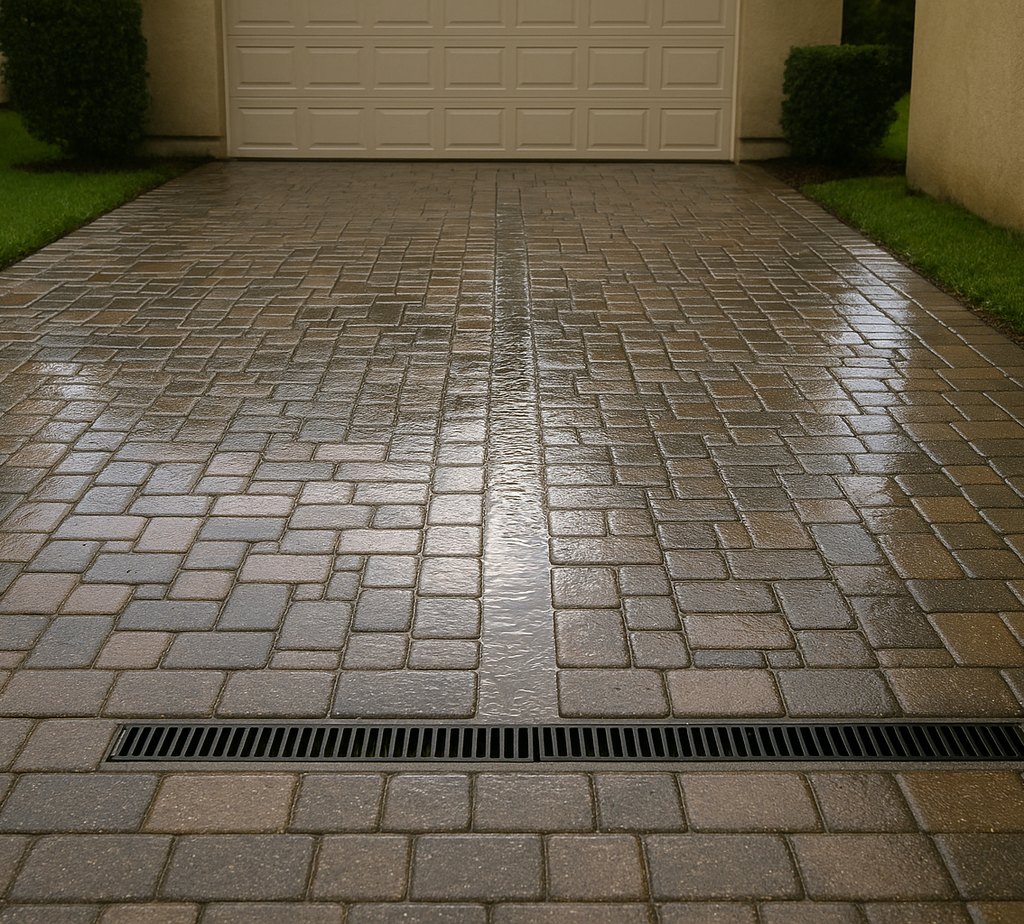
Missing or failed edge drainage. A well-built paver driveway sheds water off the surface and away from the structure. When edge drainage is missing, undersized, or clogged, stormwater has nowhere to go but under the pavers, and once it is running beneath the surface it is washing out base fines and bedding sand with every rain. In our climate, a driveway that cannot get water off itself quickly during the summer rainy season is a driveway that will settle.
How a Pro Diagnoses the Cause Before Touching a Paver
This is where experience earns its keep. Anyone can lift a paver and dump in more sand. A professional’s job is to figure out why the section sank before repairing it, because the wrong fix — no matter how neatly done — just fails again. Here is how a proper diagnosis goes.
- String line and level check. We run a string line and use a level to map the exact shape of the depression — how deep it is, how far it spreads, and how the slope has changed. We are checking it against that target of roughly a quarter inch of fall per foot, so we know exactly how much the section has dropped and where the grade needs to end up.
- Probing for soft spots and voids. We probe the base through the joints and around the low area to feel for softness and hollow pockets, then lift a test paver to inspect the bedding sand and base directly. That test lift tells us whether the sand has washed away, whether the base is loose or eroded, and how deep the trouble goes.
- Tracing the water path. We follow the water — where downspouts discharge, how the yard grades, where puddles form, whether edge drainage is working. This is the step that separates a load problem from a drainage problem. Sometimes the base failed purely from poor compaction under vehicle weight; sometimes it failed because water has been running under it for years; often it is both, and both have to be addressed.
- Deciding the scope. With that information, we can size the repair honestly. An isolated settle over a sound base is a spot re-level. Widespread base failure, deep ruts, or extensive washout calls for opening and rebuilding a larger section. And if drainage is the root cause, that has to be corrected or the repair will not hold no matter how well the pavers are reset.
The diagnostic below is how we mentally sort the most common symptoms we see on Jacksonville driveways — what each one usually means, what we check to confirm it, and what the fix typically involves. Notice how rarely a full tear-out is the answer.
| Symptom you see | Most likely underlying cause | What a pro checks to confirm | Typical fix | Full tear-out needed? |
|---|---|---|---|---|
| Isolated sunken paver | Localized bedding-sand washout or a small soft pocket in the base | Lifts the paver to inspect bedding sand and probe the base below | Spot re-level: re-screed sand to grade and reset the paver flush | No |
| Wheel-track ruts | Under-compacted base consolidating under repeated vehicle load | String line to map rut depth; probes base density along the tracks | Section rebuild: open the tracks, re-compact or add base, reset | No — affected section only |
| Broad low spot holding water | Base washout from concentrated runoff and/or poor grade | Traces water path, checks fall per foot, probes for voids | Drainage correction first, then base rebuild and re-level | No — but fix drainage too |
| Pavers lifting, then later sinking | Tree root heave, followed by a void when the root decays | Inspects for active vs. decayed roots below the lifted area | Root management, backfill the void, rebuild base, reset pavers | No — localized area |
Lifting and Re-Leveling a Section Without Tearing It Out
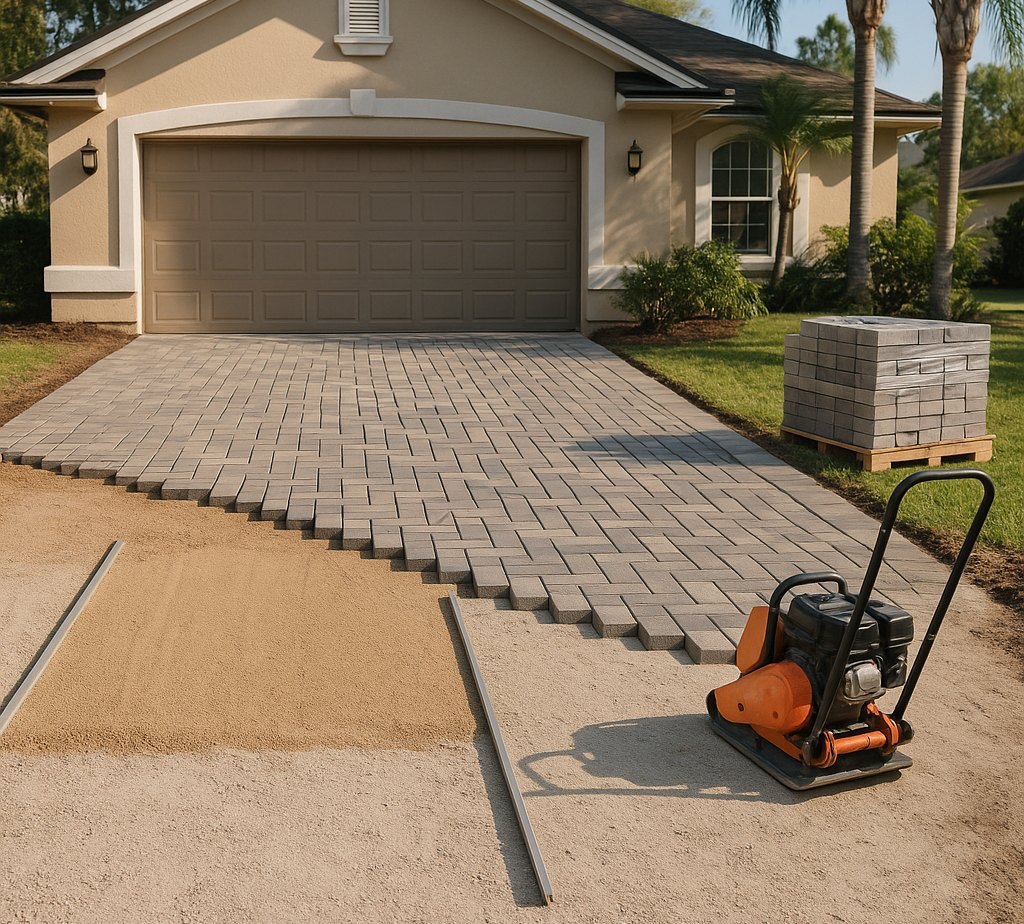
This is the part that surprises homeowners who assume a sinking driveway means starting over. It almost never does. The single biggest advantage of a paver driveway over a poured concrete slab is that it is modular. A cracked, settled concrete slab has to be broken out and repoured as a unit. Pavers come up and go back in. That means a crew can open only the failed area, fix what is wrong underneath, and reset the original pavers — and when it is done well, the repaired section blends right back into the rest of the driveway.
Done correctly, a re-level follows a clear sequence:
- Lift the affected pavers. Only the sunken section is carefully pulled up and set aside in order, so the same pavers go back where they belong.
- Correct the base. This is the whole point of the repair. Loose base gets re-compacted; washed-out or eroded base gets fresh crushed stone added and compacted to the right depth. Voids get filled. If the base was too thin to begin with, this is where it gets built up properly.
- Re-screed the bedding sand to grade. A fresh, level layer of bedding sand is screeded so the reset pavers land at exactly the right height and slope — restoring that quarter-inch-per-foot fall so water sheds instead of pools.
- Reset the pavers flush. The original pavers go back in, seated level with the surrounding field.
- Re-sand and compact the joints. New joint sand is swept in and the section is compacted so the pavers re-interlock and lock the surface back together.
Now, the warning. There is a shortcut that a lot of homeowners try and that some low-cost outfits will sell you: just lift the pavers, throw in some sand, and drop them back down — or worse, only sweep new joint sand across the top. If the base underneath is sound, that can be fine. But if the base is what failed — and on a sinking driveway it usually is — this shortcut only buys you a few months. The pavers will look level for a season, then sink right back into the same soft or hollow base that was never fixed. You cannot solve a foundation problem by adjusting the surface.
So when is a straightforward re-level enough, and when does more need to happen first? A re-level alone is the right call when the base is fundamentally sound and the pavers simply need to be reset to grade over a fresh bedding layer. But when the underlying base has failed or drainage is feeding water under the driveway, those have to be corrected as part of the repair — rebuild the base to the proper depth, redirect the water, add or fix edge drainage — otherwise you are just resetting pavers over the same conditions that sank them. The honest version of this work costs a little more effort up front and then it holds. The cheap version comes back.
Get a Straight Diagnosis Before Anyone Lifts a Paver
We’ll map the low spot, check the base and the water path, and tell you honestly whether it’s a spot re-level or a section rebuild — no tear-out sales pitch.
Preventing It From Coming Back in the Jacksonville Climate
Fixing the sinking is half the job. Keeping it from returning is the other half, and in our climate that comes down to managing water and catching small problems early.
- Correct the grade and the runoff. The most important prevention step is making sure water leaves the surface fast, especially during the June-through-September rainy season. That means confirming the driveway sheds toward the correct slope, extending downspouts so they discharge well away from the pavers, and adjusting irrigation so it is not soaking the base day after day. Get the water off and away and you starve the failure of its main fuel.
- Re-sand and seal the joints on a schedule. Joint sand is what locks pavers together and resists washout. Periodically re-sanding the joints and sealing the surface stabilizes that sand, hardens the joints against erosion, and keeps water from flushing the bedding layer out from underneath. It is inexpensive maintenance that directly prevents the sand-washout failures described above.
- Consider permeable pavers or added edge drainage on tough lots. If your property is low-lying, marsh-adjacent, or prone to standing water, it is worth talking about permeable paver systems or adding proper edge drainage during a repair. These options are built to handle the water volume that overwhelms a conventional base on flood-prone Jacksonville lots.
- Inspect the apron and wheel tracks annually. Because the apron and the wheel paths settle first, a quick once-a-year look at those areas will catch a section that is just beginning to drop. A settling spot caught early is a small, clean spot re-level. The same spot ignored for two rainy seasons can become a rutted, washed-out section that needs a full rebuild. Early beats extensive every time.
Frequently Asked Questions
Why is one section of my paver driveway sinking but the rest is fine?
How do I know if the base under my pavers has failed or washed out?
Can sunken pavers be fixed without replacing the whole driveway?
Why does water pool in low spots on my paver driveway after rain?
What causes ruts and tire tracks to form in a paver driveway?
Does Florida’s sandy soil make paver driveways sink faster?
How much does a settling paver driveway spread if I ignore it?
Sinking Driveway? Let’s Get It Diagnosed Right
A sinking paver driveway in Jacksonville is almost never a lost cause, and it is almost never a reason to tear out the whole thing. It is a signal that something underneath — the base, the bedding sand, the drainage, or all three — needs attention. Read the symptoms, understand that our sandy soil and heavy rain make a properly built and well-drained base non-negotiable, and get the real cause diagnosed before anyone starts lifting pavers. Fix the foundation, correct the water, reset the pavers flush, and keep an eye on the apron and wheel tracks, and that driveway will stay level for years.
If you are seeing ruts, a stubborn puddle, or a paver that has dropped, do not wait for the next rainy season to make it worse. We will map the problem, tell you honestly whether it is a spot re-level or a section rebuild, and repair it without tearing out your driveway.
Ready to Stop the Sinking for Good?
Coastal Driveway Pavers diagnoses and re-levels sinking paver driveways across Jacksonville — fixing the base and drainage so the repair actually lasts.