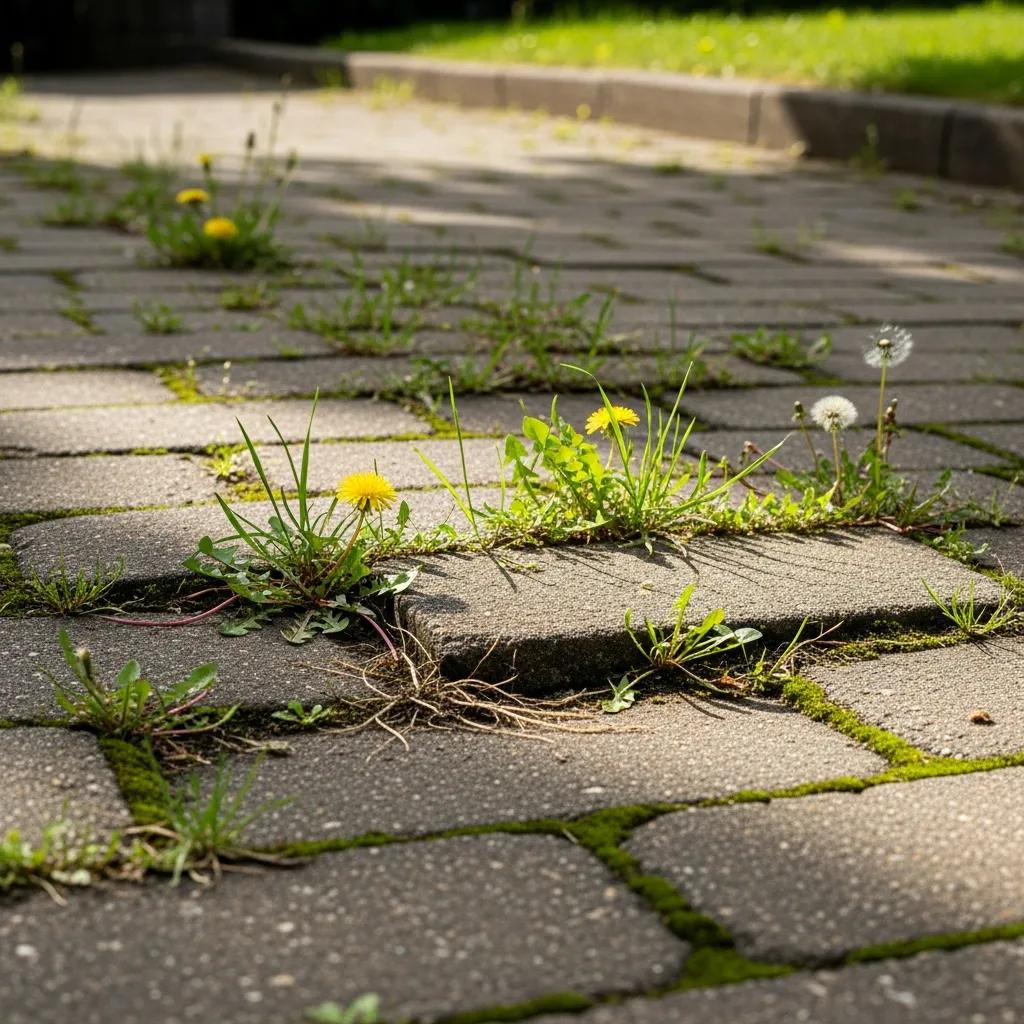
I have been installing and sealing paver driveways in Duval and St. Johns counties for over a decade, and I will tell you straight: driveway paver sealing Jacksonville homeowners pay for goes wrong more often than it goes right. A bad sealer job in Florida lasts six months. A good one lasts four years. The difference is not the price tag on the bucket — it is the type of sealer, the moisture content of the pavers underneath, and what the dew point was doing at 7 a.m. on application day. This guide walks you through every decision point I make on a sealing project, the brands I actually buy, and the mistakes I watch homeowners repeat every spring.
Why Driveway Pavers Need Sealing in Florida Specifically
Pavers in Jacksonville take more punishment than almost anywhere else in the country. Up north a driveway fights snow, salt, and freeze-thaw. Out west it is heat and UV. Here, you get all of it minus the freeze, plus a humidity load that does not quit from May to October. Five things eat unsealed pavers in Northeast Florida, and I see all of them on jobs every single month.
UV Bleach
The sun bleaches color pigment out of concrete pavers faster than most homeowners expect. A Belgard Holland Stone in Toscana that looked rich red-brown the day of install will fade to a dusty pink in 30 to 36 months on an unsealed south-facing driveway in Jacksonville. Sealer with UV inhibitors slows that to a crawl.
Pollen Stain Season
February through April, the oak and pine pollen drops yellow on every flat surface in town. On a sealed driveway, you spray it off with a hose. On an unsealed driveway, that pollen actually penetrates the open pores of the concrete and stains. I have seen unsealed driveways with permanent yellow tinting in the joints after three pollen seasons.
Oil and Tire Marks
Unsealed pavers are porous. An oil drip from a leaky valve cover sits on the surface for about 90 seconds and then it is in the stone. Same with tire marks from a car that has been sitting in summer sun — the asphalt of the road softens onto the tire, and that residue offloads onto the pavers when you pull into your driveway.
Efflorescence
This is the white chalky bloom you see on new pavers in the first six months. It is calcium carbonate working its way out of the concrete as the pavers cure. You cannot stop it. You can only let it finish, and that is the single biggest reason we do not seal a brand-new driveway right away.
Joint Sand Washout
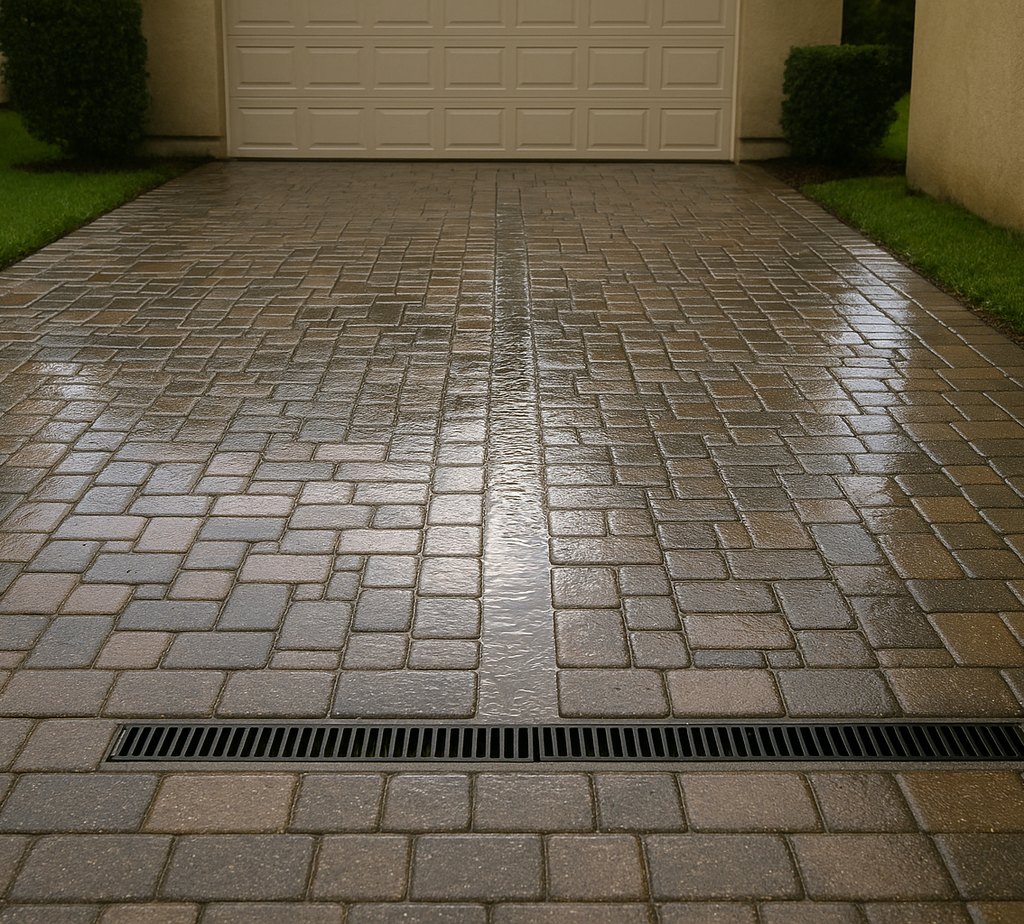
Hurricane season is the real test. A category 1 in Jacksonville will dump 8 to 12 inches in 36 hours. Unsealed joint sand — even polymeric — will get scoured out of the joints, especially on any slope over 3 percent. Sealed joint sand stays put. That alone justifies the cost of sealing for most driveways I work on.
When to Seal a NEW Paver Driveway: The 60-90 Day Rule
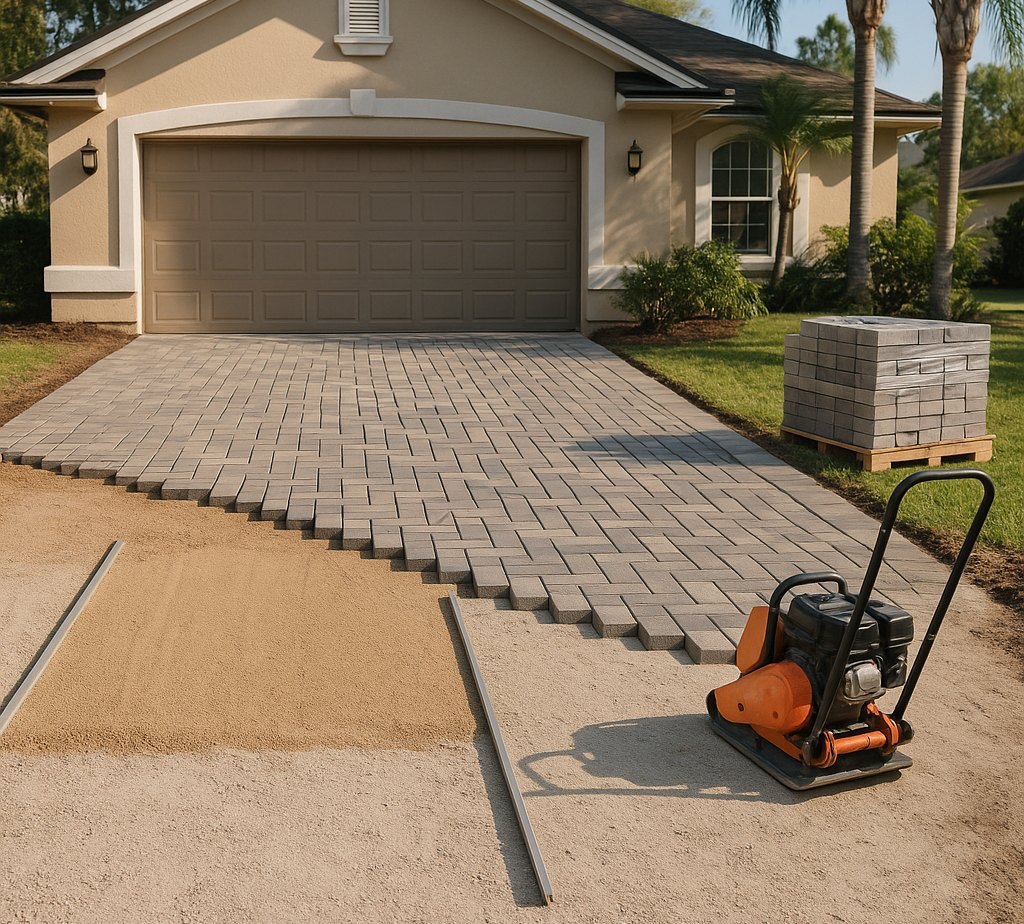
Do not let anyone seal your new pavers the week after install. I do not care how much they discount it. Concrete pavers need to finish their initial efflorescence cycle and the bedding sand needs to settle and re-key under traffic. Both of those processes need to happen before any sealer goes on, or you trap the efflorescence under the sealer and end up with a permanent white haze you cannot fix without a chemical strip.
The window I use is 60 to 90 days minimum after install, and ideally after at least one heavy rain event so the joints have had a chance to settle. In Florida summer, when efflorescence accelerates, I will push it out to 120 days. The pavers will tell you they are ready: the white bloom stops showing up after a power wash, and the joints have firmed up to where a screwdriver tip does not sink into the sand.
What About Manufactured Pavers Marketed as “Pre-Sealed”?
Tremron, Belgard, and Pavestone all sell premium lines with factory color enhancement. These are not actually pre-sealed in the way a homeowner thinks of sealing. The factory treatment is mostly a color saturation step, and you still need to apply a proper sealer at the 60-to-90-day mark for joint sand stabilization and surface protection. Read the manufacturer technical data sheet, not the marketing copy.
How Often to Re-Seal in Jacksonville
Sealer marketing in Florida is full of “10-year” and “lifetime” claims. Ignore them. In Jacksonville’s UV, humidity, and salt-air load, the realistic re-seal interval is:
- Film-forming wet-look sealers: 18 to 30 months on a sun-exposed driveway, 36 months on a shaded one.
- Penetrating sealers: 3 to 5 years before re-application is needed, sometimes longer on shaded or low-traffic surfaces.
- Hybrid sealers: 3 to 4 years depending on sun exposure and the specific product chemistry.
If a contractor tells you their sealer will last 10 years on your driveway in Mandarin or Jacksonville Beach, they are either using a product not rated for Florida or they will be out of business before the warranty matters. Plan on a touch-up cycle, not a one-and-done.
Penetrating vs Film-Forming Sealers: What Survives in Florida
This is the biggest decision you will make, and most homeowners get it wrong because the showroom samples look great and nobody tells them what those samples look like after two Florida summers.
Penetrating Sealers
Penetrating sealers — Glaze ‘N Seal Penetrating Sealer, Black Diamond Stone & Masonry Sealer, SureBond SB-7000 — soak into the paver and protect from inside the pore structure. They do not change the look of the driveway. No shine, no darkening, no film on top. The big advantage in Florida: nothing to peel, nothing to yellow, nothing to fog when humidity gets trapped underneath.
The trade-off is that you do not get that “just-washed” wet look that a lot of homeowners want. You also do not get joint sand hardening — penetrating sealers do not stabilize loose joint sand the way a film-forming sealer does. For driveways with polymeric sand already locked in, this is fine. For driveways with regular silica joint sand, you will want to combine a penetrating sealer with a polymeric joint sand application or use a different sealer type.
Film-Forming Wet-Look Sealers
Film-forming sealers — Eagle Solvent-Based Acrylic, Techniseal HD, SureBond SB-1300 — sit on top of the paver and create a glossy or semi-gloss film. They look spectacular for the first 12 to 18 months. The colors pop, water beads, the driveway looks brand new.
Then Florida happens. The film yellows from UV. It hazes from moisture trapped underneath when sealing humidity was too high. It peels in patches around the tire paths where heat from your car amplifies the surface temperature. By month 20 to 24, a film-forming sealer applied in Jacksonville often looks worse than no sealer at all, and stripping it costs more than the original application.
I will install film-forming sealers when a homeowner specifically wants the wet look and understands the maintenance cycle. But I am clear with them: this is a 24-month sealer in Florida, not a 5-year product, regardless of what the can says.
Hybrid Options
Hybrid sealers like Techniseal NaturalLook+ and SEK SureBond SB-9000 try to give you the benefits of both. They penetrate the paver while leaving a low-sheen surface film that enhances color without going fully glossy. In Florida these perform better than full film-forming sealers because the film layer is thinner and less prone to peeling, but they still do not last as long as a pure penetrating sealer. Plan on 3 to 4 years.
DIY Sealing: When It Works and When It Ruins Your Driveway
I am not going to tell you not to DIY a driveway sealing job. Plenty of homeowners do it well. But there are four conditions you absolutely have to nail, and if you cannot control them, you should hire it out.
The Humidity Window
Sealer applied above 70 percent relative humidity will not cure properly. It will haze, it will streak, and in worst cases it will turn milky white permanently. In Jacksonville, that means you cannot seal in the morning during summer when dew is on the pavers, you cannot seal in the late afternoon when the sea breeze pulls humidity up, and you cannot seal within 24 hours of any rain. The sweet spot is a dry stretch in late October through early December, or late March through May before the summer storm pattern sets in.
Application Temperature
Sealer chemistry is rated for application between roughly 50 and 90 degrees Fahrenheit surface temperature. In Jacksonville summer, an asphalt-adjacent paver driveway can hit 140 degrees by 11 a.m. Apply sealer at that surface temp and the solvent flashes off before the resin can level out. You get pinholes, streak marks, and an uneven cure. Seal early morning after dew has evaporated, or wait for an overcast day.
Joint Sand Activation
If you are using a film-forming or hybrid sealer to lock the joint sand, the sand has to be dry and clean when you apply. Any moisture in the joints turns into vapor under the sealer and you get a foggy joint that looks awful and trps moisture against the pavers. Sweep the joints, blow them out with a leaf blower, and let them sit 24 hours after any rain.
Application Thickness
More sealer is not better sealer. Two thin coats with full flash-off between coats outperforms one thick coat every single time. A thick application traps solvent, prevents proper curing, and is the number one cause of the milky-white haze I get called out to fix.
If you cannot control humidity, temperature, joint dryness, and coat thickness, hire it out. The cost of stripping a botched DIY job and re-doing it is typically 2 to 3 times what professional sealing would have cost from the start.
Real Cost of Driveway Sealing in Jacksonville
Real numbers, not marketing numbers.
DIY Materials
For a typical 600-square-foot Jacksonville driveway, DIY materials run $300 to $600 depending on sealer choice:
- Penetrating sealer (Glaze ‘N Seal or Black Diamond): $180 to $260 in product, plus $40 in applicator pads, rollers, and a pump sprayer.
- Film-forming sealer (Eagle Solvent or Techniseal HD): $280 to $420 in product, plus the same $40 in supplies.
- Polymeric joint sand if you are re-sanding (SEK SureBond HP NextGel or Techniseal NextGel): $60 to $90 per 50-pound bag, and a typical driveway needs 2 bags.
Add a pressure washer rental at $60 for the day if you do not own one, and you are at $400 to $700 all-in for materials.
Professional Pricing
Professional driveway sealing in Jacksonville runs $1.50 to $3.50 per square foot depending on sealer type, surface prep needed, and whether polymeric sand is included. The breakdown I see across the market:
- Penetrating sealer only, no joint sand work: $1.50 to $2.00 per square foot.
- Film-forming wet-look with surface prep: $2.25 to $2.75 per square foot.
- Full re-sand with polymeric, deep clean, and premium sealer: $2.75 to $3.50 per square foot.
On a 600-square-foot driveway, that is $900 to $2,100 professional cost. The reason a homeowner pays the upcharge is that the pro is buying contractor-grade sealer (not the homeowner-grade version of the same brand), has the equipment to apply two thin coats consistently, and knows the humidity window for the next 72 hours. At Coastal Driveway Pavers, we walk every driveway before we quote and tell the homeowner what sealer their specific paver type and exposure actually needs, because a north-facing shaded driveway in Riverside has different sealer requirements than a south-facing driveway in Ponte Vedra getting full sun and salt air.
The 5 Most Common Paver Sealing Mistakes Florida Homeowners Make
1. Sealing Too Soon
The number one mistake is sealing pavers within the first 30 days of install. Efflorescence gets trapped, joint sand has not settled, and you end up with a hazy driveway that requires a chemical strip to fix. Wait the 60 to 90 days. There is no good reason to rush.
2. Sealing Wet Pavers
Pavers that look dry on the surface can still have 6 to 8 percent moisture in the pore structure 48 hours after a rain. Apply sealer to that and the trapped moisture has nowhere to go. It vapor-locks under the sealer film and turns it cloudy white. The fix is heat-stripping or chemical stripping, both of which destroy the underlying surface treatment.
Buy a $40 concrete moisture meter or wait 4 to 5 dry days after any rain before sealing. Better yet, wait until you have a stretch in the long-range forecast where humidity stays below 65 percent.
3. Wrong Sealer for the Substrate
Solvent-based sealers and water-based sealers are not interchangeable. If your driveway was previously sealed with a water-based product and you go over it with a solvent-based product, the solvent will lift and dissolve the original sealer and you get a mess that requires a full strip to fix. Always test a small area in a corner before you commit to the full driveway.
4. Sealing on Hot Pavers
I see this every July. A homeowner is excited to get their driveway sealed, the sun is out, and they go for it at 1 p.m. The pavers are 130 degrees. The solvent flashes off in 90 seconds instead of the 8 to 12 minutes needed for the resin to level. The finished sealer looks streaky, has pinholes, and does not bond properly. Seal early morning after dew has burned off, or wait for an overcast day with surface temps under 90.
5. Applying Too Thick
I have already covered this but it is worth repeating because it is the second most common mistake after sealing too soon. Two thin coats. Full flash-off between coats. Do not pool sealer in the joints, do not flood the surface, do not try to do it in one pass. Patience is the entire game.
How to Tell If Your Driveway Needs to Be Re-Sealed Now
You do not need to be on a strict calendar. The driveway will tell you when it is time. Here is what I check for on the walk-around:
The Water Test
Spray a section of the driveway with a garden hose. If the water beads up and runs off, the sealer is still active. If the water darkens the pavers and soaks in within 60 seconds, the sealer has worn through and re-application is due.
Color Fade
Look at the color of pavers under your car or under planters where they are protected from sun. Compare to the open driveway. If the open driveway looks dusty or significantly lighter, UV has been hitting unsealed stone and you are overdue.
Joint Sand Recession
Stick a screwdriver into a joint. If it sinks more than a quarter inch below the paver surface, your joint sand has been washing out and you need to re-sand and re-seal before the next hurricane season.
Stains That Will Not Pressure Wash Off
If you pressure-wash the driveway and the oil drip stains or tire marks do not come up, the protective layer is gone and contaminants are now in the pore structure. Time to re-seal — and depending on stain severity, time to consider a chemical clean before sealing.
The team at Coastal Driveway Pavers will do this walk-around for free if you are not sure where your driveway is in its cycle. We would rather tell you “wait another year” and earn your trust than sell you a sealing job you do not need yet.