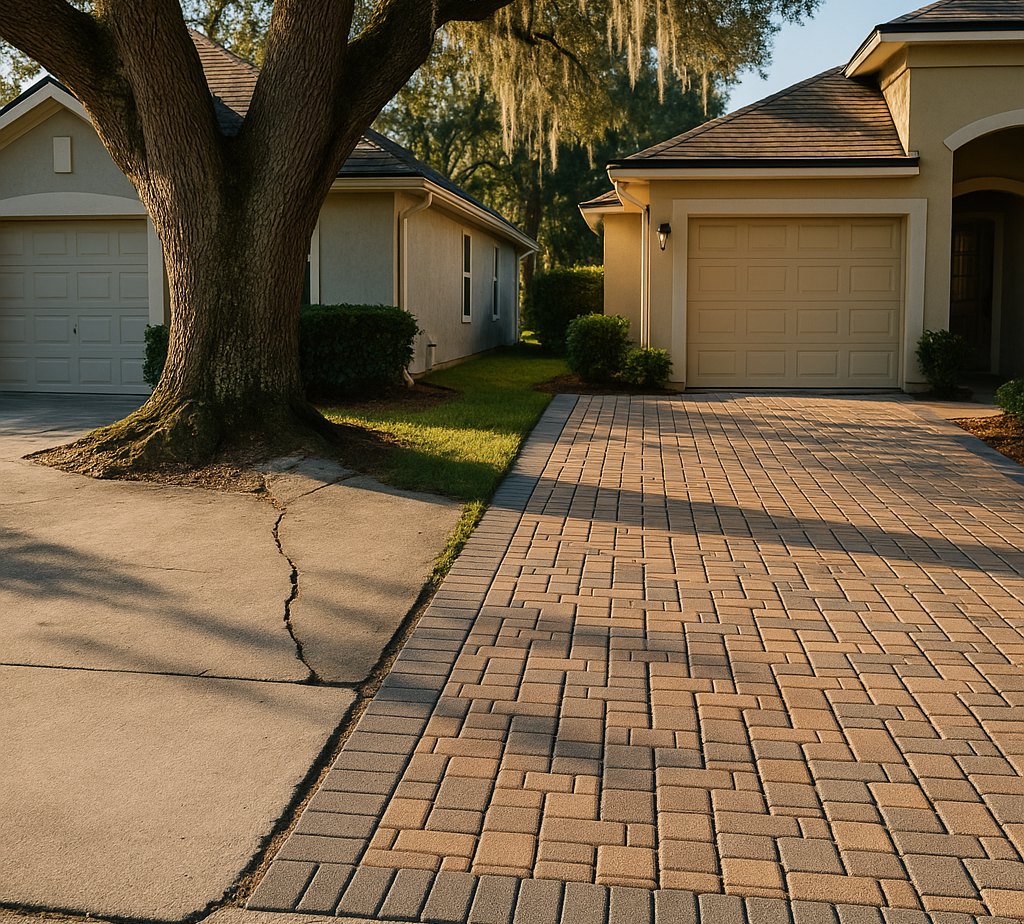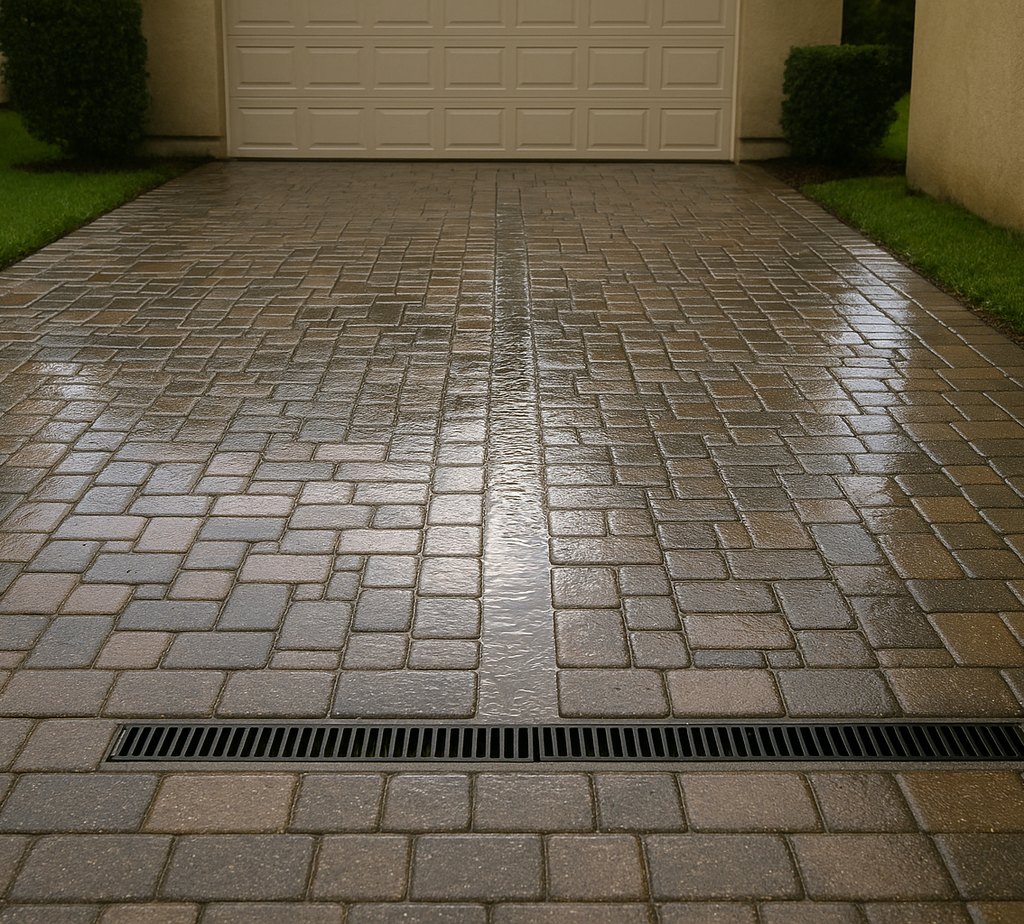
Walk any paver driveway in Jacksonville that has been down five years or more and the story is always written in the joints. Tight, level, weed-free joints mean the driveway was built right and maintained right. Sunken, washed-out, weed-filled joints mean sand has been leaving the system every time it rains — and the pavers are already starting to move.
Polymeric sand is the product that decides which of those two driveways you end up with. It is also one of the most oversold and most frequently misapplied materials in the hardscape business, especially in a climate like ours.
The short version: polymeric sand is the right choice for the vast majority of Jacksonville paver driveways — but only when the joints are the correct width, the pavers are bone dry, and it is installed on a day the forecast actually cooperates. Get any of those three wrong and you get a hazy, crusty, half-failed surface that costs more to fix than it did to install.
What polymeric sand actually is
Polymeric sand is graded joint sand blended with binding polymers. You sweep it into the joints dry, sweep the surface completely clean, then mist it with water in stages. The water activates the polymers, and the sand sets up into a firm, slightly flexible joint that locks the pavers into a single interlocked field.
That interlock is the entire point. A paver driveway does not carry vehicle load the way a concrete slab does — it carries it by distributing force sideways through thousands of tight joints into the base and edge restraints. Lose the joint sand and you lose the load path. That is why a driveway with washed-out joints starts rutting and dipping long before the pavers themselves wear out, and it is the root cause behind most cases of a paver driveway sinking in Jacksonville.
Polymeric sand vs. regular paver sand
| Polymeric sand | Regular joint sand | |
|---|---|---|
| Holds up to rain | Bonds and resists washout | Washes out steadily — the main failure mode here |
| Weeds and ants | Largely blocked — no loose medium to root or burrow in | Open invitation to both |
| Cost per bag | $30–$89 | $5–$12 |
| Install forgiveness | Low — mistakes are permanent and visible | High — just sweep more in |
| Re-sanding interval | Roughly 8–10 years | Every 1–3 years in Florida |
On a driveway — as opposed to a low-traffic garden path — the math is not close. Regular sand on a Northeast Florida driveway is a recurring maintenance bill with a slow structural failure attached to it.
Why Florida is harder on joints than the label assumes
Most polymeric sand instructions are written for a temperate climate. Jacksonville is not that. Three local conditions change how the product behaves:
- Summer downpours arrive fast. Polymeric sand needs a dry cure window — commonly cited as several hours minimum. A 3 p.m. thunderstorm on a joint installed at 1 p.m. will flush the polymers out and leave a weak, discolored joint.
- Humidity means pavers are rarely truly dry. Moisture trapped in the paver surface is the number one cause of polymeric haze, that milky film that will not sweep off.
- Our sand base drains fast but moves. Joints on a Florida driveway flex more than the brochure photos, which is why the flexible-when-cured products outperform the rigid budget ones here.
Deep dive: what causes polymeric haze, and can it be removed?
Haze is polymer residue that cured on the paver face instead of down in the joint. It happens when sand dust is left on the surface before watering, when the pavers were damp at install, or when the surface was watered too aggressively so slurry splashed up and set. On a textured or tumbled paver it is worse, because the residue keys into the surface texture.
Light haze can sometimes be removed with a polymeric haze remover or a careful low-pressure wash within the first few days. Fully cured haze on a textured paver often needs mechanical cleaning and, in bad cases, does not come off completely. This is the single strongest argument for getting the install right the first time rather than treating it as a DIY experiment on a large visible surface.
When you should not use polymeric sand
We install it on most driveways, and we will still tell you when to skip it:
- Joints outside the product’s rated range. Most polymeric sands want joints roughly 1/8″ to 1.5″ wide. Hairline joints will not accept enough sand to bond; very wide joints need a product specifically rated for them.
- Permeable paver systems. These are engineered to drain through the joints. Sealing them with polymeric sand defeats the design — they take open graded aggregate instead.
- Pavers set over a solid concrete slab with no drainage. Water that gets in needs somewhere to go.
- A driveway that is already moving. Polymeric sand locks joints; it does not fix a failing base. If pavers are dipping or rocking, the base gets corrected first — see what happens under pavers.
How it is installed properly
The sequence matters more than the brand:
- Start bone dry. Pavers and joints both. Not damp, not “mostly dry.”
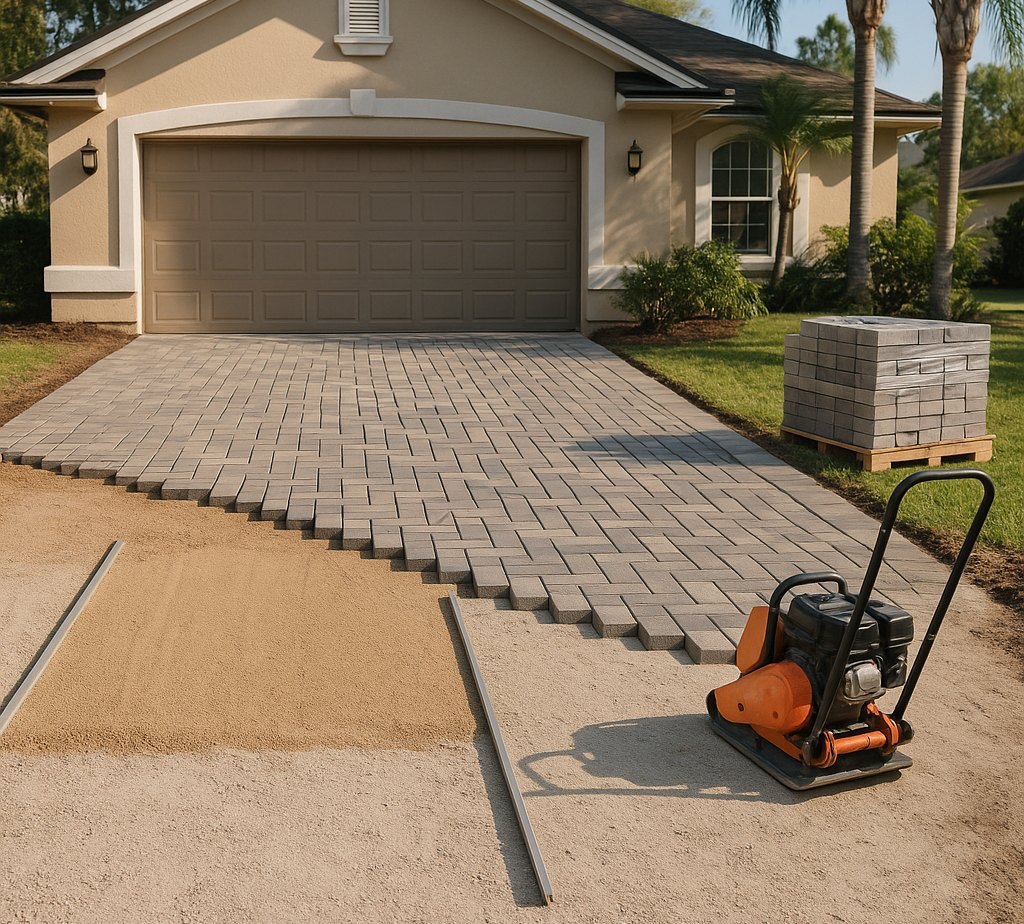
- Fill the joints fully, then compact with a plate compactor and top off. Joints settle more than people expect.
- Sweep and blow the surface obsessively. Every grain left on the paver face is a potential haze spot. This is the step DIY installs skip.
- Water in stages, in a light shower pattern, letting each pass soak before the next. Blasting it with a hose creates slurry and washouts.
- Protect the cure. No vehicles for the manufacturer’s stated window, and no rain in the forecast.
One Florida-specific rule: do not sand and seal on the same day. Joints need to cure fully before any sealer goes down, and sealing over uncured polymeric sand traps moisture and locks in haze. Our guide to driveway paver sealing timing covers the correct sequence.
Frequently asked questions
What are the downsides of using polymeric sand?
Cost, and a very low tolerance for installation error. It runs several times the price of regular joint sand, and mistakes — haze on the paver faces, joints that did not bond because they were too narrow or got rained on — are visible and hard to reverse. Done correctly on a driveway, it still pays for itself in reduced re-sanding and far less joint washout.
When should you not use polymeric sand for pavers?
Skip it on permeable paver systems that are designed to drain through the joints, on joints outside the product’s rated width range, and on any driveway whose base is already failing. Fix the base first — polymeric sand locks joints together, it does not stabilize what is underneath them.
What is the difference between polymeric sand and paver sand?
Paver sand is plain graded sand used both as a bedding layer under the pavers and, in cheaper installs, in the joints. Polymeric sand is joint sand with binding polymers added, so it hardens when watered. They are not interchangeable: polymeric sand is a joint product only and should never be used as the bedding course.
Can you use regular sand instead of polymeric sand for pavers?
You can, and on a low-traffic garden path it is defensible. On a Jacksonville driveway it is a poor trade. Our rain washes regular joint sand out steadily, and every millimetre of joint sand lost is interlock lost, which is what leads to shifting, rutting, weeds, and ant nests.
Does polymeric sand harden like cement?
No, and it should not. It cures firm but slightly flexible so joints can move with the base instead of cracking like rigid grout. A joint that has gone rock hard and brittle is usually a sign of an over-watered install or the wrong product for the application.
How big of a gap can polymeric sand fill?
Most standard products cover roughly 1/8″ to 1.5″. Wider joints, common with flagstone and some tumbled pavers, need a product specifically rated for wide joints. Always check the bag against your actual joint width before buying — this is the most common purchasing mistake we see.
How often does polymeric sand need to be replaced?
On a properly installed Jacksonville driveway, expect roughly 8–10 years before joints need attention, versus every 1–3 years with regular sand. Spot re-sanding of high-traffic areas, especially the turning zone near the street, is normal well before a full re-sand is due. More in our paver driveway maintenance guide.
Joints washing out on your driveway?
Coastal Driveway Pavers installs and re-sands paver driveways across Jacksonville and Northeast Florida. We will tell you honestly whether you need a re-sand, a spot repair, or base work — before you spend money on the wrong one.