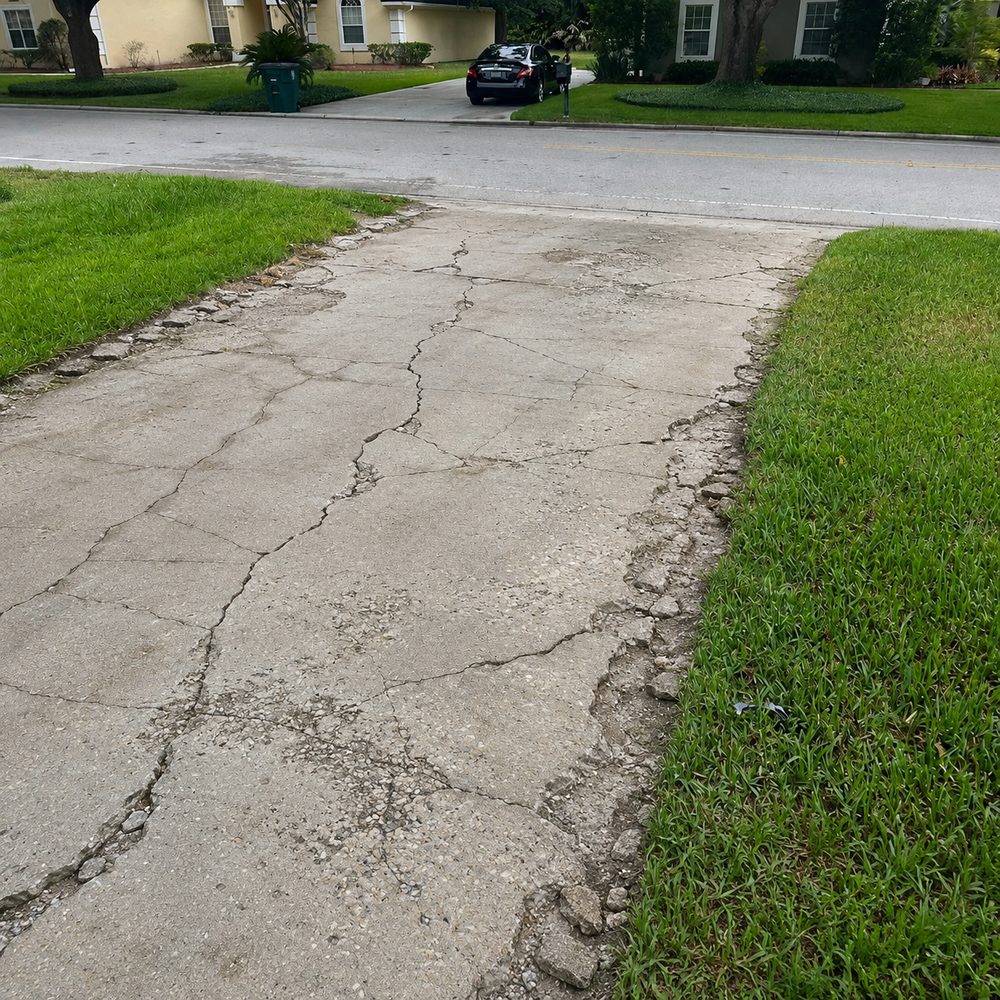
Resurfacing a concrete driveway is a genuinely good idea on some slabs and a complete waste on others. The difference is not the product, the crew, or the finish you choose. It is what your cracks are telling you.
Every resurfacing option, whether a bagged cementitious resurfacer, a spray texture, or a poured overlay, is the same thing structurally: a thin bonded skin on top of a rigid slab. A skin follows what is underneath it. If the slab beneath is stable, the skin lasts. If the slab is moving, the skin cracks in the same places within a season or two, and you have paid to relocate the problem half an inch higher.
So before you take a quote, spend ten minutes reading the driveway. There are six things concrete does, and they do not all mean the same thing.
The six patterns, and what each one means
1. Crazing, a fine web of hairline cracks
A shallow network like a dried riverbed or cracked glaze. The lines do not catch a fingernail, and nothing moves.
Cause: the surface dried faster than the concrete below it, usually from finishing in direct sun.
Meaning: cosmetic only. It does not spread into structural cracking.
Verdict: resurfaces beautifully. This is the ideal candidate.
2. Surface scaling and shallow spalling
Patches where the top layer has flaked or popped off, leaving a rougher texture and sometimes exposed aggregate.
Cause: a weak or over-worked finish, or constant wetting from sprinklers hitting the same spot.
Meaning: the top layer failed, not the slab.
Verdict: resurfaces well if the damage is shallow and the slab underneath rings solid. Tap around the area first, because a hollow sound means the layer you would be bonding to has already separated.
3. Shrinkage cracks
Random, roughly vertical cracks, hairline up to about an eighth of an inch, often running between control joints. Both sides of the crack sit at the same height.
Cause: normal drying shrinkage. Almost every slab has some.
Meaning: usually harmless if they are old, stable and level across.
Verdict: fine to resurface, provided they are genuinely stable. See the movement test below.
4. Settlement cracks
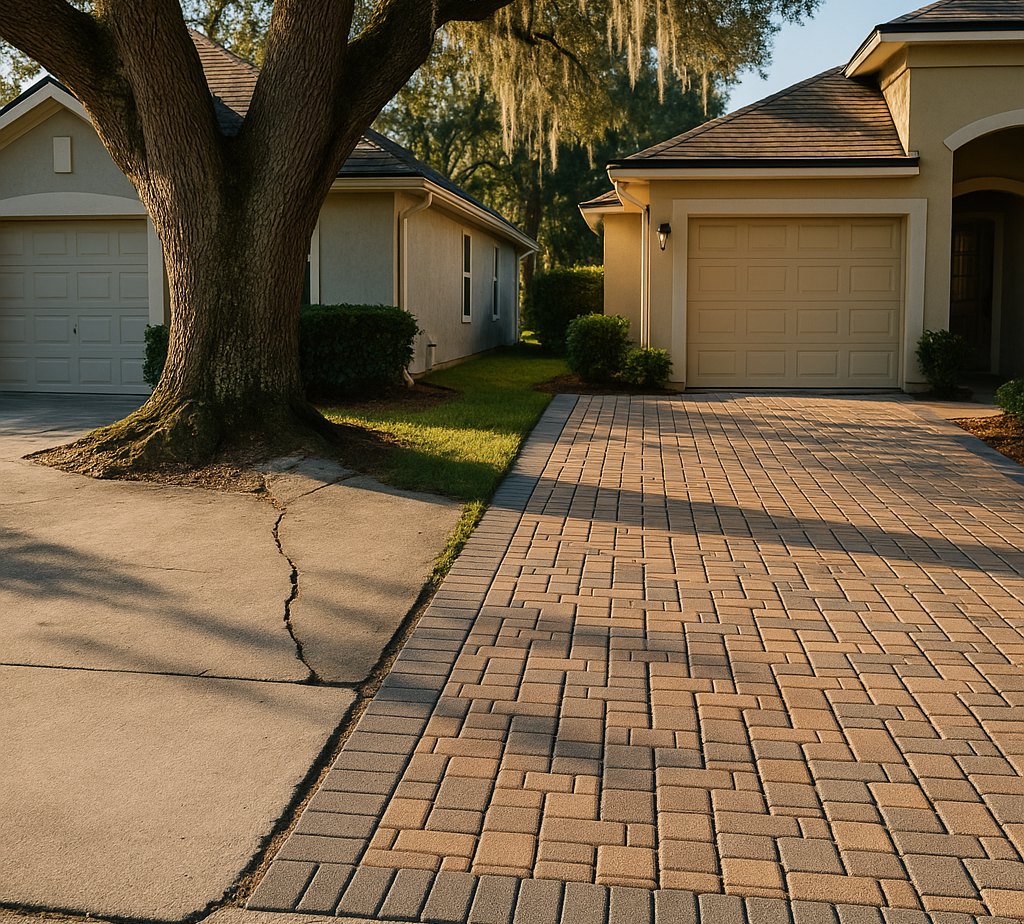
Wider cracks, frequently diagonal across a corner or running the length of the drive, and here is the part that matters: one side sits lower than the other.
Cause: the ground under the slab moved or washed away, and the concrete broke because it was no longer evenly supported.
Meaning: the slab is not the problem, the base is.
Verdict: do not resurface. An overlay adds no structural strength, and the crack reappears in the same line once the slab moves again.
5. Faulting at a joint
Two panels that meet at a control joint sit at different heights, so there is a lip across the joint.
Cause: base failure under one panel, or a root lifting it.
Meaning: same as settlement. Something under the concrete changed.
Verdict: do not resurface. You cannot feather an overlay over a moving lip and expect it to hold.
6. Spalling with rust staining
Concrete breaking away in chunks, often along an edge, with orange-brown staining and sometimes visible steel.
Cause: reinforcement corroding. Rusting steel expands and pushes the concrete off from the inside.
Meaning: structural, and progressive. It does not stop on its own.
Verdict: do not resurface. Covering it hides an active process.
The single most useful test. Run your hand across each crack. If you can feel a step, where one side is higher than the other, the slab has moved and no overlay will fix it. Level cracks are usually a surface conversation. Offset cracks are always a base conversation.
Two more checks worth doing
Is it still moving? Mark each end of a significant crack with a pencil line and a dated piece of tape, then look again after a heavy rain season. A crack that has grown is active. You can also read the edges: sharp, clean edges mean recent, while rounded and dirt-filled edges usually mean it happened long ago and stopped.
Is anything hollow? Walk the driveway tapping with something hard, or drag a length of chain across it. Solid slab rings. A dull thud means a void underneath, which is the base washed out and the single clearest sign that resurfacing is the wrong purchase.
Why this happens here
Northeast Florida driveways rarely fail because the concrete was bad. They fail because of what is under them.
Our subgrade is sand, and sand moves when water moves through it. During the wet season the water table sits close to the surface across much of Duval and eastern St. Johns County, so the ground supporting the slab is saturated and supports less. Water running off a roof, along an edge, or out of a downspout carries the fine material out of the base a grain at a time and leaves voids. Add a live oak within reach of the slab and you get lifting from a second direction.
This is the same story we have written about repeatedly on the paver side, and it applies identically to poured concrete. If anything it applies worse, because a rigid slab cannot flex over a void. It just breaks. Our post on what base failure actually looks like underneath walks through the mechanism, and why the base matters more than the surface covers what a proper base is supposed to do.
Which is the whole point of this article. Resurfacing is a surface decision. Most Northeast Florida driveway failure is a base problem. Those two things have to match up or you are buying the wrong repair.
How to choose between the three paths
Once you know your pattern, the choice collapses into three paths: resurface, repair the specific cracks, or rebuild. What separates them is how much service life the slab has left. Level, dormant cracks over concrete that rings solid mean only a tired finish; offset cracks, hollow areas or rust staining mean that life is spent, and no overlay adds it back.
| Path | Choose it when the slab reads | Disruption | How long it lasts |
|---|---|---|---|
| Resurface with a bonded overlay | Level, dormant cracking or shallow scaling, solid when tapped | A few days, mostly waiting on cure | A finish: seal on a cycle, redo eventually |
| Rout and seal the cracks | A few stable, level cracks in an otherwise sound slab | Hours, rarely the whole driveway | The sealant is a consumable and gets renewed |
| Replace the slab | A step across a crack, faulting, hollow areas, or rust staining | Demolition, haul-off and rebuild | Decades, if the base is rebuilt not reused |
Solved, or just covered? Resurfacing and crack repair work on top of the slab, so neither touches the base. Where the base is sound, that is right. Where it has washed out, both cover the evidence and leave the cause running. Only replacement opens the ground up.
What to ask before you accept a resurfacing quote
A contractor who has diagnosed your slab answers these five without hesitating. One who has only measured it gets vague, and that is the signal. Our guide to what belongs in a full driveway scope does the same for a replacement.
1. Did you sound the slab, and what did you find? Ask where they tapped and what rang hollow. A void underneath should stop the job, and checking takes minutes.
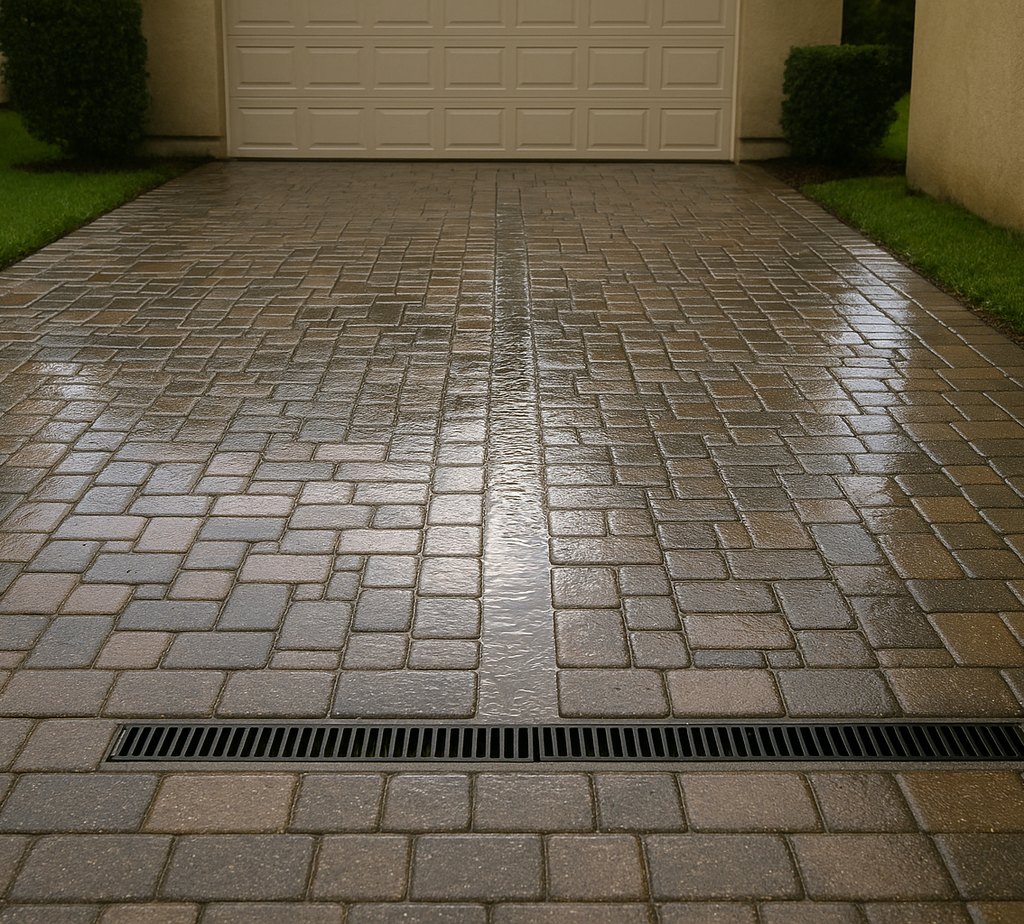
2. Where is the water going? A downspout onto the slab, a sprinkler soaking one edge, or fall toward the garage will treat the new surface as it treated the old.
3. How are you handling my control joints? Joints exist so the slab cracks where somebody chose. They have to be carried up through the overlay and left open, not skimmed across.
4. What preparation is included, specifically? Pressure washing is cleaning, not preparation. Ask about mechanical profiling, cutting delaminated material back to solid concrete, treating cracks first, and the bonding agent.
5. What happens if a crack telegraphs through? Get the answer into the written scope. Telegraphing is how these jobs most often disappoint, and plenty of warranties exclude it by name.
The case for not resurfacing at all
If your slab passes the tests, resurfacing is a legitimate purchase and we are not going to talk you out of it.
But it is worth being honest about what it buys. An overlay is a finish, and finishes in full Florida sun are consumables. It will need maintenance, it will eventually need redoing, and it does nothing at all for the base underneath. If the driveway is 25 years old, sitting on a base nobody has looked at since it was poured, resurfacing is a cosmetic answer to a structural question.
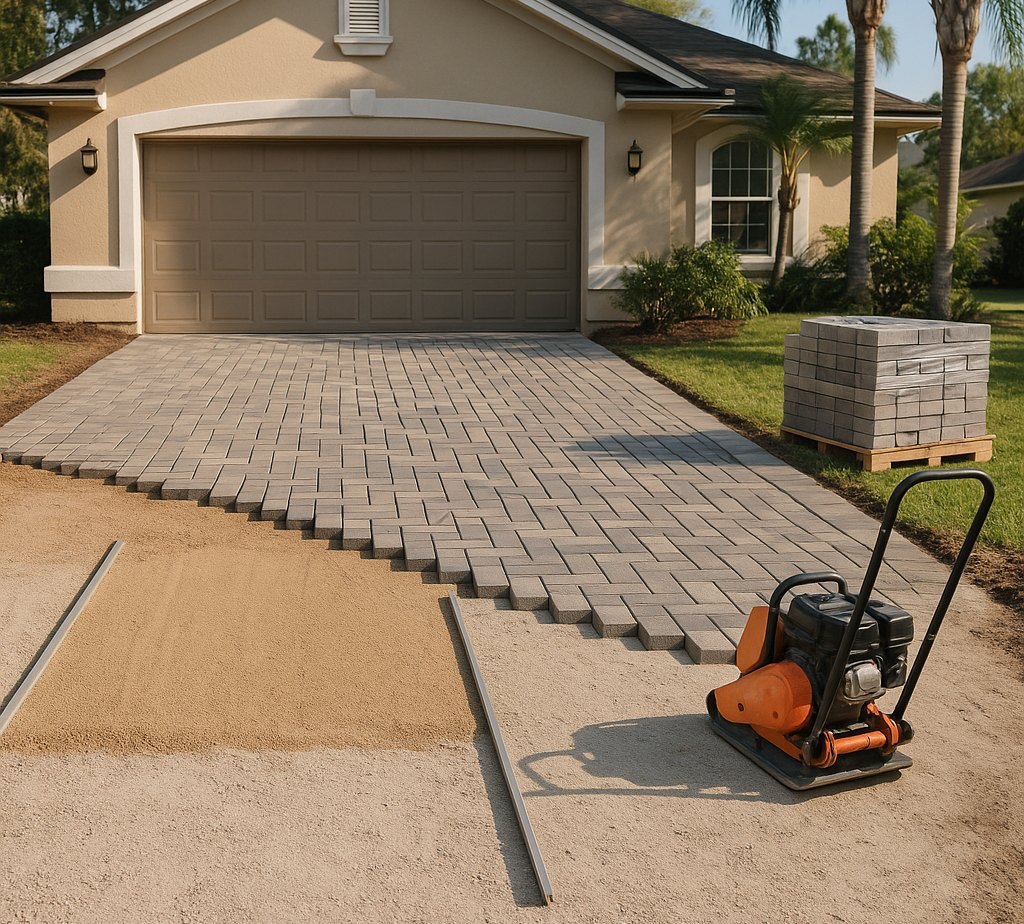
The alternative argument is durability over a longer horizon. Pavers ask more of you up front and give more back over time, because individual units can be lifted and reset when the ground inevitably moves, which is not something you can do with a slab. That trade-off is the whole subject of the full pavers vs. concrete comparison, and if you like the look of a finished surface, how stamped concrete holds up in Florida is the closer comparison.
Frequently asked questions
Is resurfacing a driveway a good idea?
How long does a resurfaced driveway last?
Do I need a permit to resurface a driveway in Northeast Florida?
What is the best way to resurface a concrete driveway?
Can I pour 2 inches of concrete over existing concrete?
What are the downsides of a concrete overlay?
How do I know whether my driveway needs replacing instead?
Does resurfacing fix a sinking driveway?
Get someone to read the slab before you buy a surface
The useful visit is the one where somebody tells you which of the six patterns you have. That is a ten minute assessment, and it decides whether you are buying a finish or a driveway, and whether you buy it once.
We install paver, brick, travertine, natural stone and poured concrete driveways across Northeast Florida, so we have no stake in steering you toward one material. If your slab is sound, we will tell you it is sound. If the base has gone, we will show you why we think so.