A driveway only has one drainage job, and it is a simple one. When it rains, the water has to leave, and it has to leave in a direction that does not end up in your garage.
In Northeast Florida that job gets tested harder than almost anywhere. A summer afternoon storm can drop an inch of rain in under an hour, straight down, onto a surface that has been baking in the sun all day. Any flaw in how the driveway was built shows up within minutes: a puddle that sits by the garage door, a sheet of water running toward the house, sand washing out of the joints and collecting at the curb.
This guide covers how a paver driveway should be built to shed that water, how to read the signs when it is not, and when a problem is a quick fix versus a rebuild.
The short version. A driveway drains by slope, not by soaking water up. Standard pavers shed water across their surface much like concrete, so the fall built into the driveway is what does the work, ideally about a quarter inch per foot and always away from the house. Puddles in one spot usually mean the base has settled there. Water across the whole drive usually means it was built too flat. The first is a small reset. The second is a rebuild.
Water leaves by slope, not by soaking in
It is a common assumption that a paver driveway drains through the gaps between the pavers. Standard pavers do not, at least not in any useful amount.
The joints on most driveways are filled with sand or polymeric sand, and polymeric sand is designed to set up and resist washout. Very little water gets through it during a heavy storm. So a normal paver driveway sheds rain across its surface, the same way a concrete driveway does, and the thing that moves the water is the fall built into the surface.
The exception is a permeable paver system, which uses wider joints filled with open graded stone over a base built to hold and release water. That is a different kind of driveway designed from the ground up for infiltration, not a regular paver driveway with a different joint fill.
How much slope a driveway actually needs
Slope is usually talked about as a percentage or as inches of fall per foot.
A common target for a driveway is about 2 percent, roughly a quarter inch of fall for every foot. At around 1 percent, an eighth of an inch per foot, a driveway is about as flat as it can be and still drain reliably. Build flatter than that and water will sit anywhere the surface is even slightly uneven, which on a surface made of thousands of individual units is everywhere.
The direction matters as much as the amount. A driveway can be:
- Pitched in one direction, usually toward the street or a swale
- Cross sloped from one side to the other, shedding water into the lawn or a landscaped edge
- Crowned in the middle, shedding water to both sides like a road
Which one is right depends on the lot. What is not negotiable is that the water heads away from the house, the garage and your neighbor’s yard.
The garage threshold, where most problems start
The spot where the driveway meets the garage is where drainage mistakes cost the most.
Ideally the driveway falls away from the garage door from the very first paver. But a lot of Jacksonville lots do not cooperate. The garage sits lower than the street, or the drive has to climb before it drops, and the natural fall runs straight toward the door.
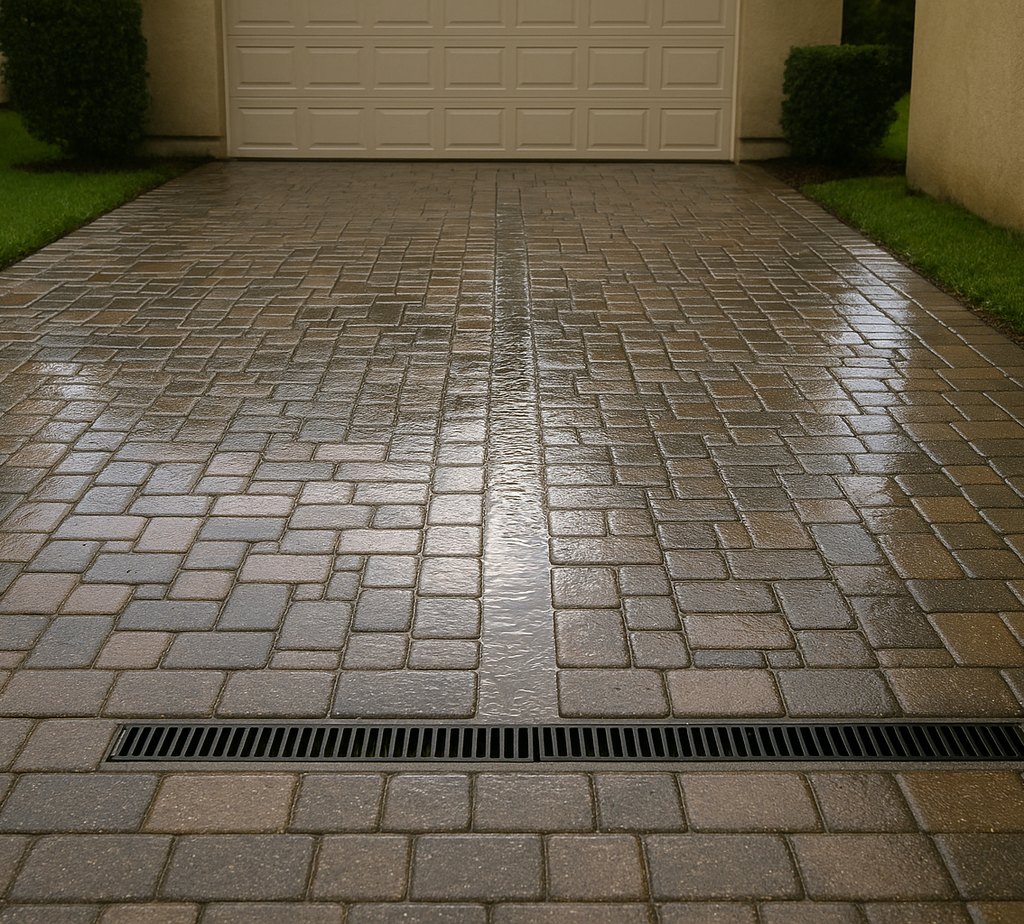
When that happens, the water has to be intercepted before it reaches the garage. The usual answer is a linear drain set across the driveway at the threshold, a narrow channel with a grate that catches the water and carries it away. A drain like that is only as good as what happens after it, so it needs somewhere to discharge: to daylight in a lower part of the yard, or into an approved drainage system. A drain that simply fills up and overflows is not a drain.
Where the water comes from matters too
Not all of the water on a driveway falls on it. A lot of it arrives from somewhere else.
Downspouts are the big one. A gutter that empties onto the driveway can deliver the runoff from a whole section of roof onto one small area of pavers, all at once. That concentrated flow is often what washes joint sand out in one particular spot.
Irrigation is the other. A sprinkler head that throws onto the driveway every morning keeps the same area wet, washes sand from the joints and encourages algae in the low spots. Adjusting the head is free and fixes more driveway staining than most people expect.
Neighboring lots and the street can also send water across a driveway, especially on older streets where the road has been resurfaced higher over the years.
Signs your driveway is not draining properly
A few things are worth watching for after a heavy storm.
- Puddles that stay for more than an hour or so after the rain stops
- Water running toward the garage or collecting against the door
- Sand washing out of the joints and gathering at the edges or the curb
- Dark, green or slick patches where water sits and algae grows
- Pavers rocking or sinking, usually in the same area as a recurring puddle
- Edges crumbling or pavers creeping outward along the border
The pattern tells you a lot. A single puddle that always forms in the same place points to settlement in that one area. Water sitting across the whole width of the driveway points to a driveway that was built too flat to begin with.
Why a low spot forms in the first place
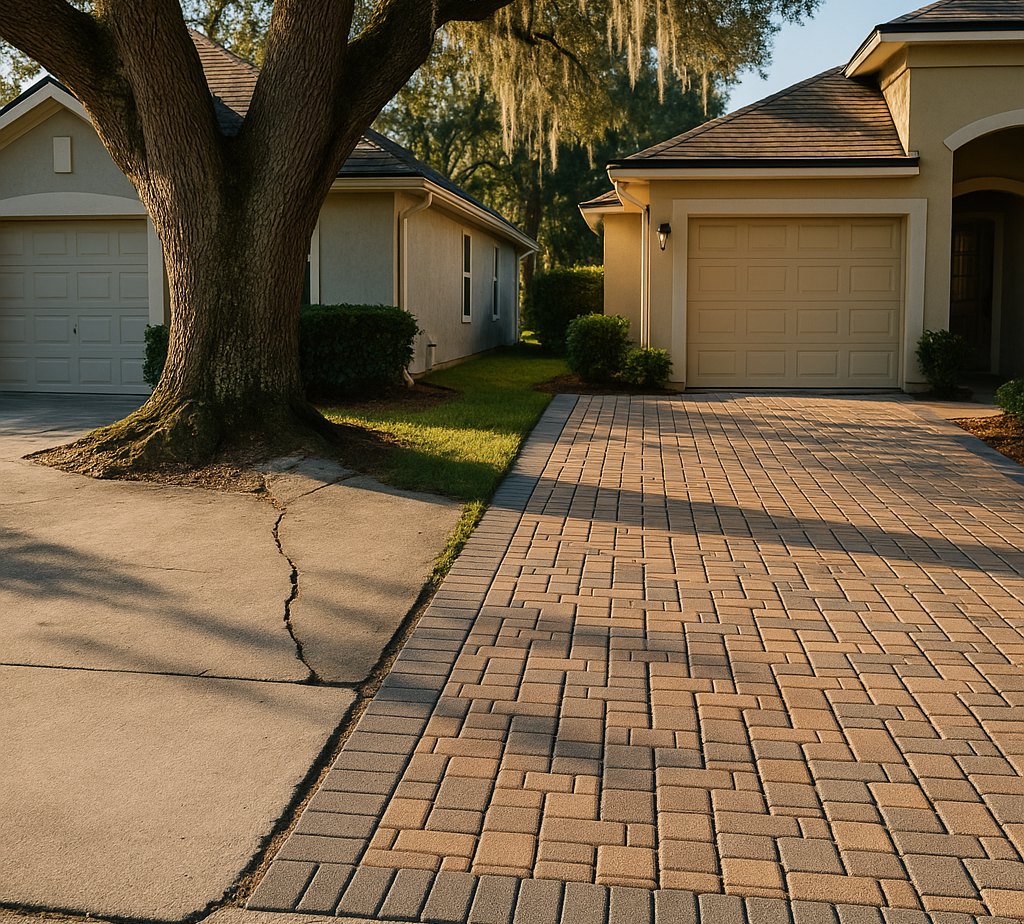
Pavers sit on a bedding layer of sand, which sits on a compacted base. If the base under one area was not compacted properly, was too thin, or has had water running through it for years, it can settle, and the pavers above it settle with it.
Once a shallow dip forms, it gets worse on its own. Water collects there, soaks into the joints, softens the base a little more and deepens the dip. The fix is to deal with the base, not just the surface.
A strong edge restraint along the border matters for the same reason. Without it, pavers at the edge slowly migrate outward, joints open up, and water and sand start moving where they should not. Our guide to polymeric sand for paver driveways covers the joint side of this in more detail.
Reset or rebuild?
This is where pavers have a genuine advantage over poured concrete.
If the problem is one isolated low spot, the pavers in that area can be lifted, the base underneath corrected and compacted, and the same pavers laid back down. Done well, you cannot tell where the work was. With a concrete slab, the same problem means cutting out and repouring a section.
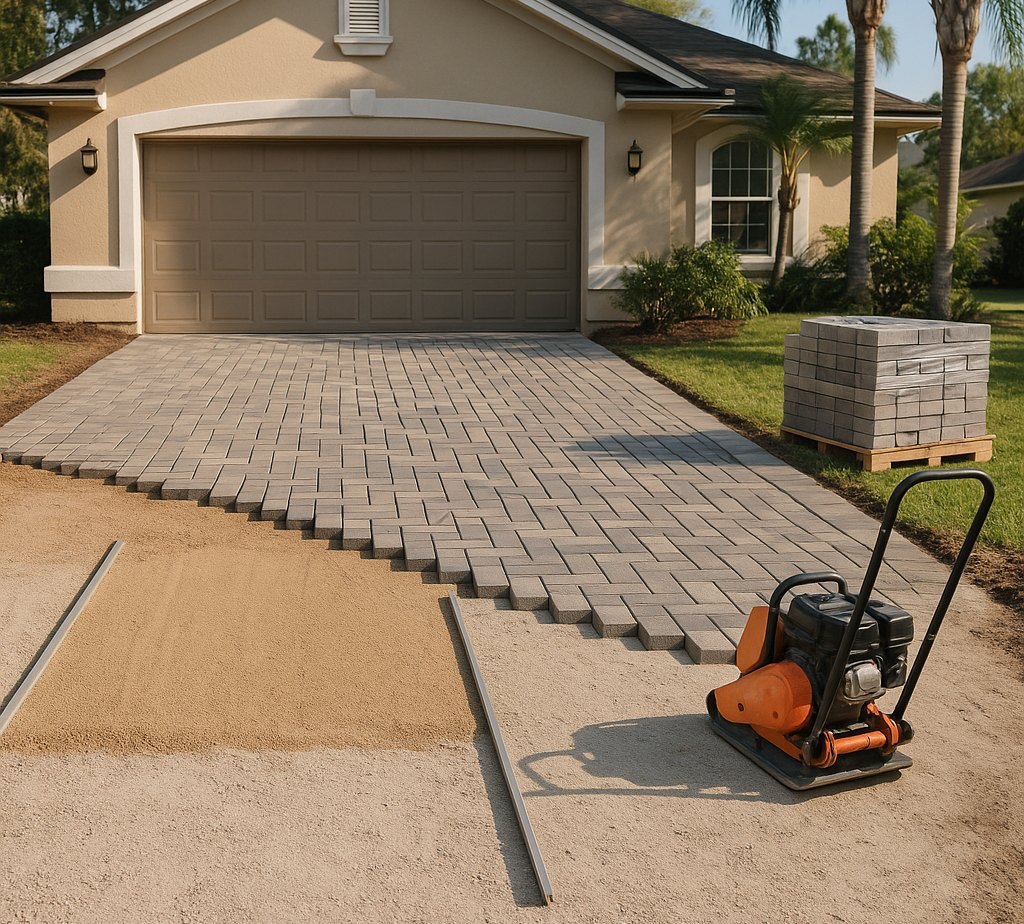
If the problem is the whole driveway, because it was built too flat or pitched the wrong way, or the base has failed across a wide area, patching one spot at a time will not solve it. That is when it makes sense to lift the pavers, regrade the base with the right fall and relay the driveway properly. If your pavers are in good shape, a relay can often reuse them.
Concrete driveways have their own version of this question, and our guide to reading the cracks in a concrete driveway covers when resurfacing is enough and when it is not.
Frequently asked questions
How much slope does a driveway need to drain?
Why is water pooling on my paver driveway?
Do pavers drain better than concrete?
Should a driveway slope toward the garage?
Can a low spot be fixed without replacing the whole driveway?
Find out where the water is actually going
Stand in the driveway during the next afternoon storm and watch. Where does the water run, where does it stop, and does any of it head toward the garage? That ten minutes will tell you more than any drawing.
Coastal Driveway Pavers has been building paver driveways across Duval, Nassau, St. Johns and Clay counties for over a decade, and every one of them starts with where the water goes. The full scope is on our driveway installation and driveway replacement pages.