# Commercial Paver Parking Areas in Jacksonville: Load, Cross-Slope and Stormwater on a Business Property
Your lot is rutting, or a new building is going up, and someone has put interlocking pavers in front of you instead of asphalt. The decision is not whether pavers look sharper than a black lot. It is whether the surface carries your delivery truck, drains during a Jacksonville August, holds up at the accessible parking and the route to your front door, and lets you stay open while the work happens.
The short version. A commercial parking area is a designed pavement, not a scaled up driveway. Trucks set the base, not cars. Vehicular pavers are thicker and shorter than residential units and get laid in a different pattern. The surface has to shed water while the accessible spaces and the route to your entrance stay inside the slope limits the accessibility standard sets. Permeable systems can change how a site handles stormwater, but only if the engineer designs the reservoir and the district signs off. And when something fails or a utility has to be reached, the units come up and go back down instead of the area getting milled and repaved.
A parking area is not a big driveway
On a residential driveway the heaviest thing that touches the surface is a pickup. On a business property the cars are almost irrelevant to the structural design.
Your real design vehicles show up on a schedule: the front load trash truck that lands on the same spot every week, the box truck at the receiving door, the fire apparatus that has to reach the building. Pavement damage rises with roughly the fourth power of axle weight, so one loaded truck axle does more than thousands of car passes.
That means the lot is not one pavement. Stalls see light static loads. Drive aisles see everything that enters. Turning points, the receiving apron, the fire lane and the dumpster pad see the worst of it, with braking and steering shearing the surface sideways instead of just pressing down. Those areas get a heavier section, and the dumpster pad gets treated separately again, because a front load truck sets outriggers and lifts several tons at a fixed point.
What carries the load is the base, not the paver
The unit you see is a wearing surface. What holds up the truck is everything under it.
Our soils are largely sand. Sand drains, but it has almost no cohesion: it moves when wet and loaded, and the seasonal high water table sits close to the surface on plenty of Duval County sites. So the sequence is strip the organics, proof roll the subgrade so weak spots show up under load instead of under your customers, undercut and replace what fails, and separate subgrade from base with a geotextile.
Above that goes the aggregate base, in Florida typically limerock or crushed concrete, compacted in lifts rather than dumped in one layer. Thickness is calculated, not a rule of thumb: your engineer works it from the strength of the subgrade, expressed here as a limerock bearing ratio, and from the design traffic. It is not the same number across the whole lot, and compaction gets verified by density testing.
Skip any of that and the failure is predictable: ruts in the wheel paths and low spots holding water after a storm. We covered how base failure presents and how a settled area gets diagnosed in why a paver driveway sinks in Jacksonville.
Paver thickness, shape and pattern all change for vehicular use
The units that make a beautiful patio are the wrong units for a drive aisle.
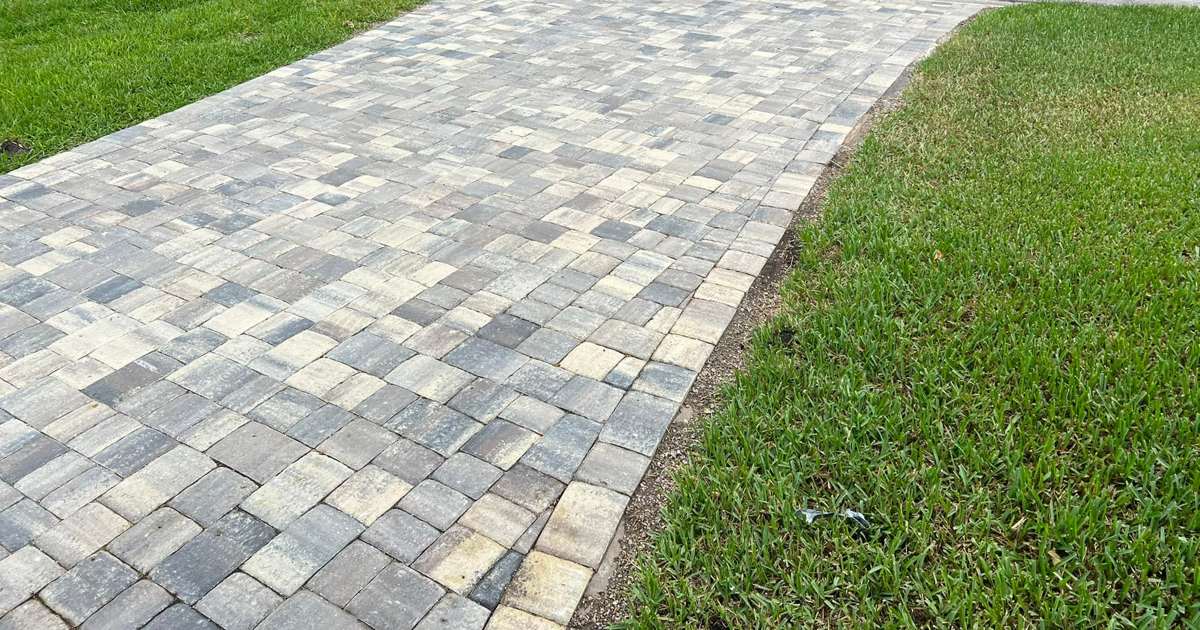
Thickness is the obvious one. Sixty millimeter units, roughly two and three eighths inches, are the residential driveway standard. For commercial vehicular traffic the industry standard moves to eighty millimeter units, roughly three and an eighth inches, meeting the ASTM specification for solid interlocking concrete paving units. Coastal Driveway Pavers partners with trusted U.S. manufacturers to supply durable paving materials that meet commercial grade standards, and that submittal belongs in your file before anything is ordered.
Shape matters nearly as much. Long, thin, plank style units want to rotate under a turning tire. Shorter units whose length is only a few times their thickness lock into their neighbors and stay put. Pattern follows the same logic: herringbone, laid at forty five or ninety degrees to the direction of travel, resists the creep that braking and steering push into the surface. Running bond looks tidy in a rendering and walks apart in a drive aisle.
Underneath, the bedding layer is a thin, screeded course of properly graded sand, not a thick leveling course used to hide a bad base. The joints then get filled and compacted so units transfer load sideways, which is why an interlocking pavement stiffens over its first weeks under traffic.
Cross-slope, accessible parking and the route to your door
Here is the tension nobody warns a property owner about. The lot has to slope enough to move water to the inlets. The accessible parking spaces, their access aisles, and the accessible route to your entrance have to stay close to level, with limits on both running slope and cross slope. Those requirements pull in opposite directions, and they meet right at your front door.
The accessible route and spaces have to meet the accessibility standard and the Florida accessibility provisions, and the specific figures appear on your civil drawings. Those drawings govern. Anyone quoting a slope number off the top of their head on a walkthrough cannot back it up at inspection.
What the installer owes you is the ability to hit whatever the drawings call for, and that is where a unit paver surface helps: elevation is adjustable unit by unit, so a crew can hold a near level plane across an accessible space while the lot keeps its drainage grade. The route also has to be firm, stable and slip resistant, which means joints stay full and tight so a caster or a cane tip cannot drop into them.
Where your property meets the public sidewalk, a different set of rules takes over, because that connection sits in the right of way and follows the city process rather than your site plan. We covered it in our guide to driveway aprons, permits and right of way rules in Jacksonville.
Stormwater, impervious coverage and permeable systems
Every commercial site in Duval County has a stormwater story, and it decides how much of your property you get to pave. The site is permitted through the water management district and the city, the plan has to treat and attenuate runoff, and local zoning limits how much of the parcel can be impervious surface.
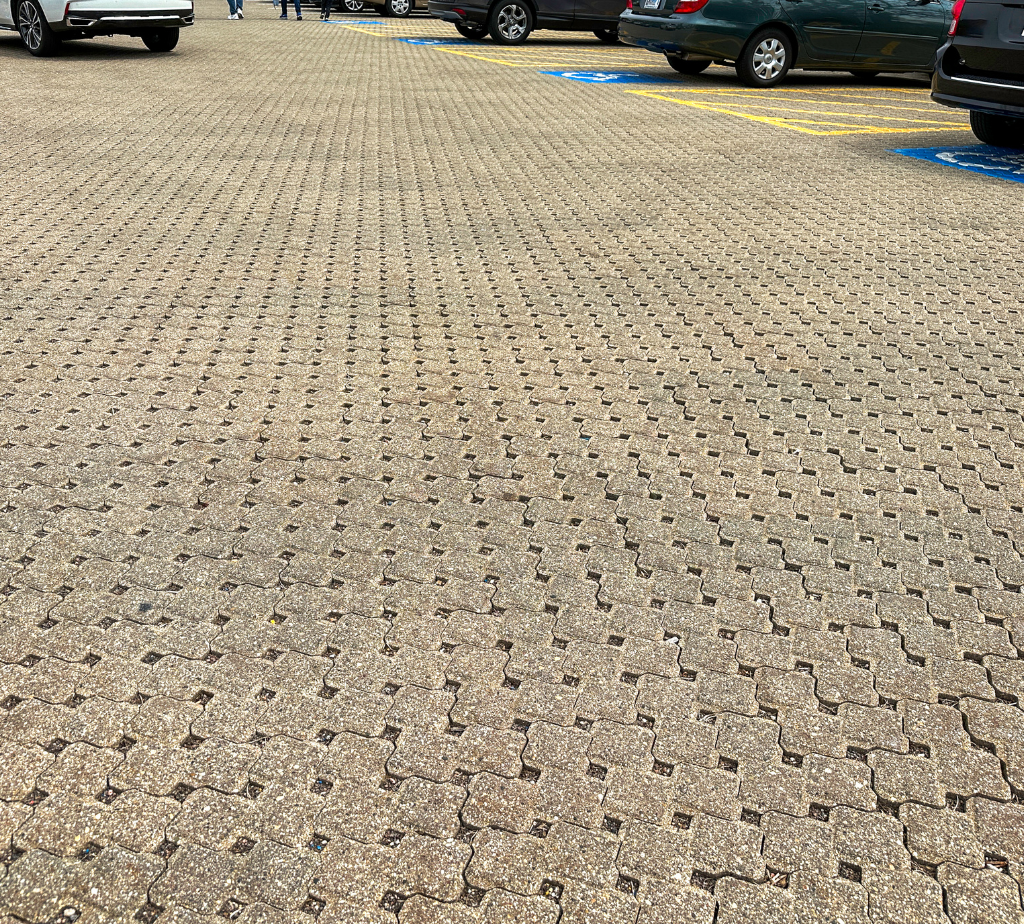
That is where permeable interlocking pavement gets interesting. A permeable system uses open graded stone in the joints, the bedding course and the base, so the stone layers become a reservoir that holds water and lets it infiltrate. On the right site that shrinks the volume the pond has to hold, or frees up land that would otherwise be a basin.
Three things decide whether it works here. First, the seasonal high water table: the district requires separation between the bottom of that reservoir and the groundwater, and on low lying Jacksonville sites that separation is what runs out. Second, whether your jurisdiction credits the area against impervious coverage, a local determination your engineer confirms first. Third, maintenance: the joints collect sediment and the surface has to be vacuum swept on a schedule to keep infiltrating. For the residential version, see our post on permeable paver driveways in Jacksonville.
Edge restraint and containment at the drive aisles
An interlocking pavement works by staying tight. The moment an edge lets go, perimeter units spread, joints open, sand washes out, and the failure walks inward.
On a residential driveway a spiked plastic or aluminum restraint is normally enough. In a commercial drive aisle it is not. The standard for vehicular edges is cast in place concrete: a curb, a curb and gutter, or an edge beam the pavers are set against.
Watch where containment gets tested: the outside of a turn where trailer tires track wide, the end of a row where vehicles cut the corner into an island, and anywhere the lot meets sod with only a plastic strip holding it.
Phasing so the business stays open
A poured surface has to cure before vehicles touch it, and it goes in as one piece. A paver surface has no such wait. Once units are laid, compacted and the joints are filled, the section takes traffic. That is what makes phased installation realistic: a row or a quadrant at a time, closed and returned to service while the rest of the property keeps operating.
Plan the phasing around your operations. Sequence around trash pickup day and delivery windows, keep a legal accessible space and a compliant route available at every stage, and keep fire lane access open. Coastal Driveway Pavers notes that most commercial paving installations are completed within one to two weeks, depending on weather and project complexity, and the weather half is not a formality here: summer storms shut down base work and compaction, so a real schedule carries rain days.
How repairs actually work later
Every parking area gets opened eventually: a grease line, an irrigation main, a conduit run, a settled area.
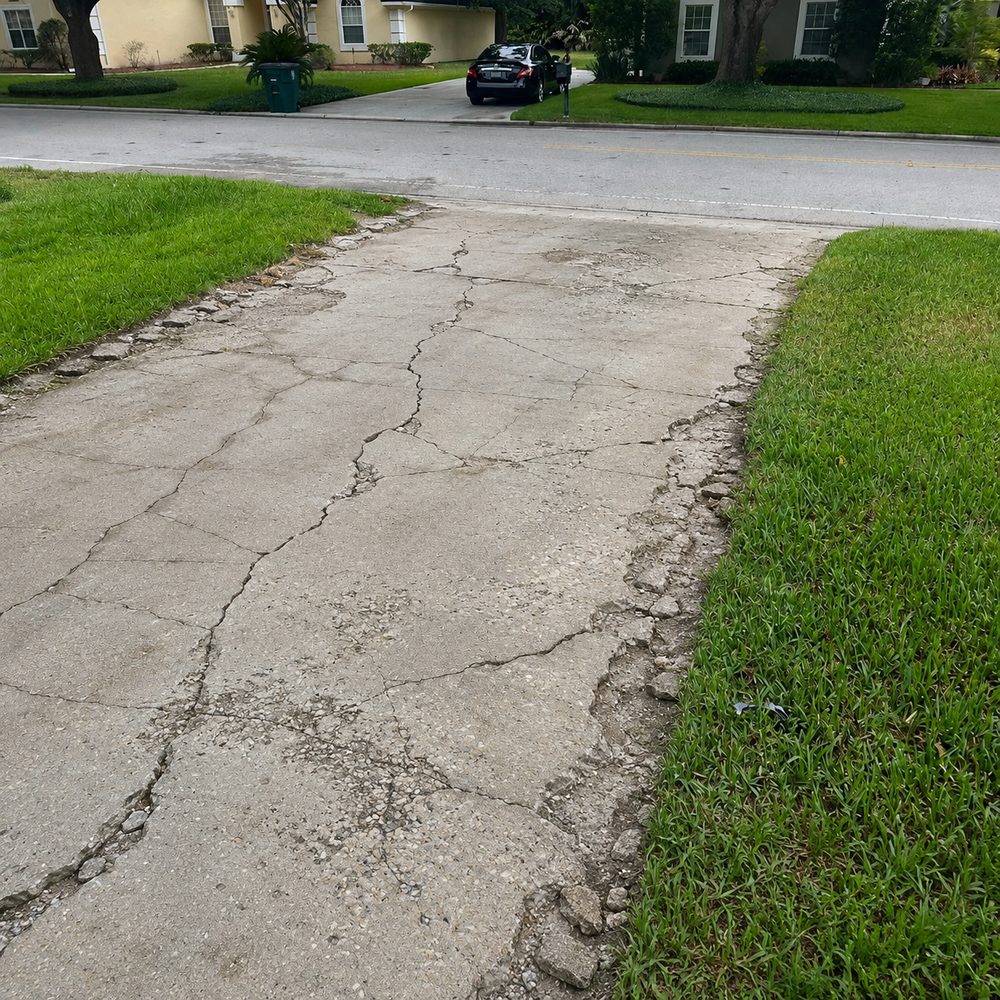
On a paver lot the affected units come up, the work happens, the base is rebuilt and compacted, and the same units go back down. There is no saw cut scar, no cold joint, no patch that never matches, and no milling of an area far larger than the problem. Settlement is handled the same way, by lifting the section, correcting what is underneath and resetting the surface, the process we walk through in the sinking driveway guide. A poured surface instead has you reading crack patterns to decide whether the slab can be resurfaced at all, which we cover in our guide to reading cracks in a concrete surface.
Keep attic stock, a pallet or two of the same units from the same run, on the property, and keep the record of what is under the surface. The same discipline behind every driveway installation is what makes a lot repairable in pieces years later.
Frequently asked questions
What are the best pavers for car parking?
Can I just lay pavers on dirt?
Is permeable paving good for parking lots?
What are the downsides of permeable pavers?
How long does a commercial paver installation take?
Get a commercial site walkthrough for your property
If you manage or own a business property in Jacksonville and the lot is rutting, ponding or simply coming due, the useful next step is having someone walk it with your drawings in hand. What matters is the traffic your site carries, what the subgrade turns out to be, how the accessible spaces are laid out, and where your stormwater goes.
Coastal Driveway Pavers specializes in commercial paver installation built to enhance the strength, appearance, and value of business properties across Jacksonville, for parking lots, driveways, plazas and entryways. Bring your plans and your operating schedule, and the phasing conversation starts on the same visit.